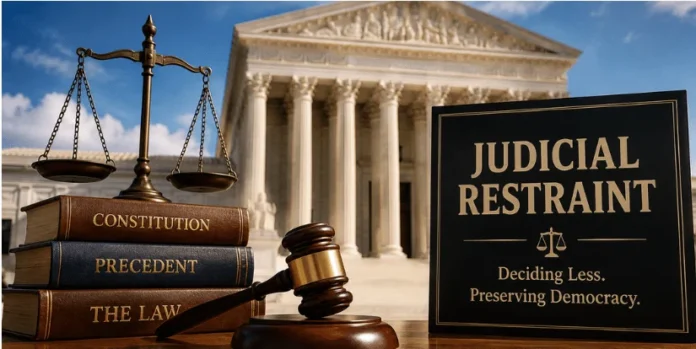
A judge can think a law is a bad idea and still vote to uphold it. That gap between what you would do as a lawmaker and what you will do in a robe is where judicial restraint lives. It is an argument about who decides, not about which answer is right. One side treats the phrase as a compliment. Critics hear a polite word for standing by while people get hurt. Strip out the politics, and judicial restraint is a set of habits that make courts decide less, decide later, or decide narrowly.
| Question | Short answer |
| What it is | A preference for deciding as little as a case allows |
| Core claim | Elected officials, not judges, should settle contested policy |
| Main tools | Standing, ripeness, mootness, political question, avoidance, precedent |
| Usual opposite | Judicial activism |
| Who says it? | Senators, nominees, commentators, sometimes judges |
| What it is not | A party, a voting bloc, or a promise about outcomes |
Key takeaways
- This philosophy is about scope, not outcomes; a modest ruling can please either party.
- Eight doctrines do the real work, and standing quietly ends most cases.
- Our highest court says no to almost every case it is asked to hear.
- Famous rulings get labeled both ways, depending on who is talking.
- In confirmation hearings, the word works as a signal, not a legal test.
What judicial restraint means in practice
Short answer. Judges who favor this approach decide only what the case in front of them requires. They defer to elected lawmakers where the Constitution is silent, and they follow precedent. They also sidestep constitutional questions they can resolve some other way. The doctrine limits how far a ruling reaches. It does not tell you who wins.
You will meet the idea on television long before you meet it in a brief. The week a nomination lands, a Sunday host like Meet the Press moderator Kristen Welker asks a senator whether the nominee legislates from the bench. Back comes the answer in this vocabulary. The legal version is duller and far more useful.
The 8 doctrines that do the actual work
This approach is not a mood. It runs on named rules, and each one hands a court a reason to stop short of the big question.
| Doctrine | What it does | Case to know |
| Standing | Demands a real injury, traceable to the defendant | Lujan v. Defenders of Wildlife (1992) |
| Ripeness | Blocks a challenge filed before the harm exists | Abbott Laboratories v. Gardner (1967) |
| Mootness | Ends a case once the fight is over | DeFunis v. Odegaard (1974) |
| Political question | Sends a dispute to Congress or the president | Rucho v. Common Cause (2019) |
| Constitutional avoidance | Reads a statute so no constitutional ruling is needed | Ashwander v. TVA (1936) |
| Presumption of constitutionality | Puts the burden on whoever attacks the law | NFIB v. Sebelius (2012) |
| Stare decisis | Keeps settled precedent settled | Planned Parenthood v. Casey (1992) |
| Narrow holdings | Decides this case only, not the next one | Masterpiece Cakeshop (2018) |
A ninth tool is not a doctrine at all. It is the docket. Through the certiorari process, the justices pick their own cases and turn almost everything down. According to the Administrative Office of the U.S. Courts, the Court accepts 100 to 150 of the more than 7,000 cases it is asked to review each year. That figure sits in the federal judiciary’s own guide to Supreme Court procedures. Filing a paid petition costs $300, and nearly every one fails. Refusing to answer is the quietest form of restraint there is.
Restraint vs. activism, side by side
This pairing is standard and also slippery. Here is the contrast, dimension by dimension. Two warnings about that table. Those are tendencies, not teams, and one judge often sits in both columns in the same term. Nobody self-identifies as an activist either.
| Dimension | Restrained approach | Activist approach |
| Precedent | Follow it unless it has become unworkable. | Overrule it when it is wrong. |
| Striking down a law | Last resort, heavy burden on the challenger | A normal part of the job |
| Contested social policy | Legislatures and voters decide. | Courts step in when politics stalls. |
| Remedy | Narrow, this case only | Broad rules for cases to come |
| Reading the Constitution | Text, structure, original meaning | Text read against changed conditions |
| Agency power | Leave technical calls to the agency | Police the agency closely. |
| Main risk | Real violations go unremedied. | Nine unelected people set policy. |
| Standard insult | “You hid behind the procedure.” | “You legislated from the bench.” |
Twelve cases, six each way
Dates and one-line holdings, so you can check any of them yourself.
Commonly cited as restraint.
- Luther v. Borden (1849): picking between two rival Rhode Island governments belonged to Congress and the president.
- Ashwander v. Tennessee Valley Authority (1936): Justice Brandeis listed seven rules for ducking constitutional rulings, starting with never deciding one you can avoid.
- Korematsu v. United States (1944): deferring to the military, the Court upheld the wartime exclusion of Japanese Americans, then repudiated the ruling in 2018.
- Lujan v. Defenders of Wildlife (1992): a general wish to see the law obeyed is not an injury, so the challengers lacked standing.
- Washington v. Glucksberg (1997): no right to assisted suicide appears in the Constitution, so the question stayed with the states.
- Rucho v. Common Cause (2019): claims that a district map is too partisan to raise a political question federal courts cannot judge.
Commonly cited as activism.
- Brown v. Board of Education (1954): segregated public schools violate the Constitution, undoing Plessy v. Ferguson from 1896.
- Roe v. Wade (1973): abortion is constitutionally protected; under a trimester scheme, the opinion built itself.
- District of Columbia v. Heller (2008): because the Second Amendment protects an individual right, the D.C. handgun ban fell.
- Citizens United v. FEC (2010): capping independent political spending by corporations and unions violates the First Amendment.
- Shelby County v. Holder (2013): the formula picking which states needed federal voting preclearance fell as outdated.
- Obergefell v. Hodges (2015): states must license and recognize same-sex marriages.
Look at that second list again. Three of those rulings landed where liberals wanted and three where conservatives wanted. A label describes how far a court reached, not which party celebrated.
The cases both camps claim
Marbury v. Madison (1803). Announcing that it could strike down an act of Congress, the Court then declined to give William Marbury the commission he came for. Audacious and modest in one opinion. Dobbs v. Jackson Women’s Health Organization (2022). The majority described handing abortion back to elected representatives. Dissenters described discarding roughly fifty years of precedent. Same ruling, opposite labels. Loper Bright Enterprises v. Raimondo (2024).
Overruling the 1984 Chevron decision, the Court told judges to read statutes for themselves. Supporters called it a return to the judicial role. Critics called it forty years of precedent thrown out. You can defend or attack all three without changing a single fact. That is the tell. Here is a political vocabulary in legal clothing.
The case for it and the case against it
Federal judges hold their jobs for life and answer to no voter. When a court settles against a contested question, the losing side has almost nowhere to go. Deference keeps the law predictable and leaves a state free to try something and get voted out for it. Standing aside has a cost, and history records it. That same instinct produced Plessy in 1896 and Korematsu in 1944, when the Court watched people lose their rights. A right that survives only at the pleasure of a majority is not much of a right. Gatekeeping is not neutral either, since a strict standing rule can shut out someone with a real injury.
This argument left the law school seminar a long time ago. Campaigns run on it now, and the loudest voices are political figures first and lawyers second. Plenty of voters know a former presidential candidate mainly from coverage of What Is an Estate? Complete Guide to Gross, Probate and Taxable Estates in 2026. They still hear his version of it, because “courts or elected officials” is a campaign question too.
How the label shows up in confirmation hearings
Every nominee gets asked some version of the same question, and nearly every nominee answers with modesty. In September 2005, John Roberts opened his hearing with a line people still repeat: judges are like umpires, and umpires do not make the rules; they apply them. That promise limits while committing to no result at all.
Senators from both parties use the vocabulary, and each side means something different by it. One wants to hear that a nominee will respect precedent. Another wants a nominee who will strike down laws that overstep. No wrong answer is on offer, which is why the exchanges feel hollow.
Then the clips go to cable, where personalities argue about them for days. A reader can look up Lauren Boebert’s height on Monday and read a Supreme Court syllabus on Tuesday. That is no knock on voters. It does mean the phrase travels much further than the doctrine underneath it.
Conclusion
Judicial restraint is ultimately about the proper limits of judicial power. Its emphasis on narrow decisions, precedent, procedural doctrines, and deference to elected institutions can promote stability and prevent courts from becoming substitute legislatures. At the same time, excessive restraint can leave serious constitutional violations without an effective remedy.
The 8 doctrines and 12 cases discussed above show why the concept cannot be reduced to a simple conservative or liberal label. Understanding judicial restraint requires looking at the reasoning behind a court’s decision, how broadly it reaches, and whether the judges are preserving the traditional boundaries between courts and elected branches.
Apart from that, if you want to know about the article, Quash Meaning in Law: Legal Definition, Motions, Grounds, Deadlines & What Courts Can Undo, then please visit our Law Category.
Where to go next
Writing about a case? Skip the commentary first. Read the syllabus at the top of the opinion on supremecourt.gov, which gives you the holding in one paragraph. A ruling described as sweeping often decided something small. Then ask which of the eight doctrines above the Court used. That is usually the real story. One caution. This is background on how courts think, not advice about your own situation. If a ruling touches something you are dealing with, an attorney who knows your facts is the person to ask
Frequently asked questions
Neither reliably. Progressives championed deference in the 1930s, when the Court kept striking down New Deal laws. Conservatives championed it in the 1970s, after the Warren Court. Whoever is losing in coCourtends to discover the virtue of leaving things to legislatures.
No. Precedent sets a thumb on the scale, not a lock. Courts weigh how workable the old rule is, how much people relied on it, and whether its reasoning has fallen apart. Brown overruled Plessy. Dobbs overruled Roe. The fight is over when an overruling is justified.
No. Judicial review is the power to measure a law against the Constitution, settled by Marbury in 1803. Activism is a charge about using that power too freely. Courts review laws and uphold them far more often than headlines suggest.
Yes, and most are. A judge might defer to Congress on economic regulation and strike down a speech restriction in the same term. Whether that is inconsistency or a theory about which rights get close scrutiny is exactly what people argue about.
Oliver Wendell Holmes Jr. and, later, Felix Frankfurter are the names most often attached to it. Holmes dissented in Lochner v. New York in 1905, arguing the Court had no business striking down a state law on bakers’ hours.