
Watching a newborn puppy go from scooting across bedding to standing on four legs happens surprisingly fast. If you’re wondering when do puppies start walking, most begin making wobbly attempts around 2 to 3 weeks old and gain much better control by about 4 weeks. The exact day varies, so steady progress matters more than hitting one date perfectly.
Direct answer: Most pups start pushing up and taking unsteady steps at about 2–3 weeks old. By 4 weeks, they should usually be walking, playing, and exploring with better balance. A little wobbling is normal early, but persistent inability to stand or move normally deserves veterinary advice.
| Age | Typical movement milestone | What you may notice |
|---|---|---|
| Birth to 1 week | Crawling and scooting | Belly stays close to the floor |
| Around 2 weeks | Early standing attempts | Legs may shake or spread apart |
| Around 3 weeks | First recognizable steps | Short, awkward trips around the nest |
| Around 4 weeks | Walking, playing, early running | Better balance and more exploration |
| 5–8 weeks | Stronger coordination | Running, pouncing, social play |
Key takeaways: Early movement develops in stages rather than appearing overnight. Wobbly steps at 2 to 3 weeks are expected, while a four-week-old pup should generally be able to walk, run, and play. Safe footing, normal nutrition, and prompt veterinary attention for missed milestones matter more than trying to force a young dog to practice walking.
When Do Puppies Start Walking?
Puppies usually begin trying to stand in their second or third week, followed by short, poorly coordinated steps. The American Kennel Club describes the 2-to-4-week period as a major transition, with a young dog able to walk by about four weeks. VCA gives a similar timeline, noting that two-week-old pups should be trying to stand and four-week-olds should be walking, running, and playing.
That range explains why two healthy littermates may not take their first steps on exactly the same day. One may push upright early while another spends several more days crawling before its balance catches up. What matters is that strength, coordination, and mobility keep improving across this short developmental window.
A simple way to think about the process is stand, step, stabilize. First, the pup learns to support its body weight; next come a few shaky steps; then repeated movement builds enough coordination for confident walking and play. This framework is more useful than expecting a sudden change from crawling to perfect walking.
Puppy Walking Milestones Week by Week
Week 1: Crawling, Rooting, and Sleeping
During the first week, newborns are not ready to stand or walk in the usual sense. They spend much of their time nursing and sleeping, while movement mainly consists of crawling or scooting toward warmth and their mother. Their nervous system and muscles are still developing, so limited mobility is normal at this stage.
Caregivers should focus on warmth, nursing, weight gain, and a safe whelping area rather than encouraging exercise. The pup should have enough traction to move without constantly sliding, but there is no need to place it upright. Normal early development happens through everyday movement around the mother and litter.
Week 2: Standing Attempts Begin
The second week brings noticeable physical change as the senses and motor system mature. VCA notes that by two weeks, a young dog should be alert and trying to stand, although those attempts may last only seconds. Eyes also begin opening around this general period, adding another major developmental milestone.
Early standing can look clumsy because the legs do not yet provide steady support. A pup may push up, sway, collapse, and repeat the process several times in a short period. This usually reflects normal practice rather than a problem when strength and coordination continue improving.
Week 3: The First Wobbly Steps
Around week three, many pups begin taking recognizable steps instead of moving on their bellies. Rover cites veterinary guidance placing the beginning of walking around 2 to 3 weeks, while Purina notes that many dogs can walk during this same developmental period. Early gait remains unstable because balance and muscle control are still maturing.
This is also when the whelping area suddenly becomes more interesting to its occupants. A pup that once stayed near its mother may begin moving toward littermates, sounds, or nearby objects. Keep exploration closely supervised because coordination improves faster than judgment.
Week 4: Walking Turns Into Play
By roughly four weeks, mobility should look much more purposeful. AKC reports that a pup can walk by this age, and VCA says normal four-week milestones include walking, running, and playing. Short bursts of chasing, wrestling, and exploring now become part of normal development.
Occasional tumbles can still happen because coordination is not finished developing. The difference is that a healthy youngster generally gets back up and continues moving rather than remaining unable to support itself. Balance and confidence continue improving through the following weeks.
What Normal Early Walking Looks Like
A new walker often uses a wide stance, sways from side to side, and changes direction awkwardly. Those movements can look strange compared with an older dog, but early instability alone does not necessarily mean something is wrong. Steady day-to-day improvement is a reassuring sign to watch for.
You can monitor development by observing the litter during ordinary activity rather than repeatedly testing each pup. Look for attempts to rise, increasing time spent standing, movement toward littermates, and progressively smoother steps. Comparing progress over several days gives you more useful information than judging one brief stumble.
How to Help a Young Puppy Walk Safely
The best support is usually a secure environment that allows natural movement. Use clean footing that provides traction, remove gaps or objects that could trap a leg, and keep the space warm enough for newborn care. Avoid slippery floors during early practice because a pup that cannot gain purchase may struggle to use its developing muscles effectively.
Forcing a youngster to stand, pulling it upright, or repeatedly placing its feet into a walking position offers no benefit. Development should occur through normal exploration unless a veterinarian has prescribed rehabilitation for a specific problem. Gentle handling and careful observation are more appropriate than turning early walking into a training exercise.
As mobility increases, you can gradually provide safe new textures and simple surroundings under supervision. AKC guidance on early development emphasizes exposure to different safe surfaces as coordination improves. ENF Blogs’ broader pet care section can also help you plan later stages of routine care.
When Delayed Walking Needs Veterinary Attention
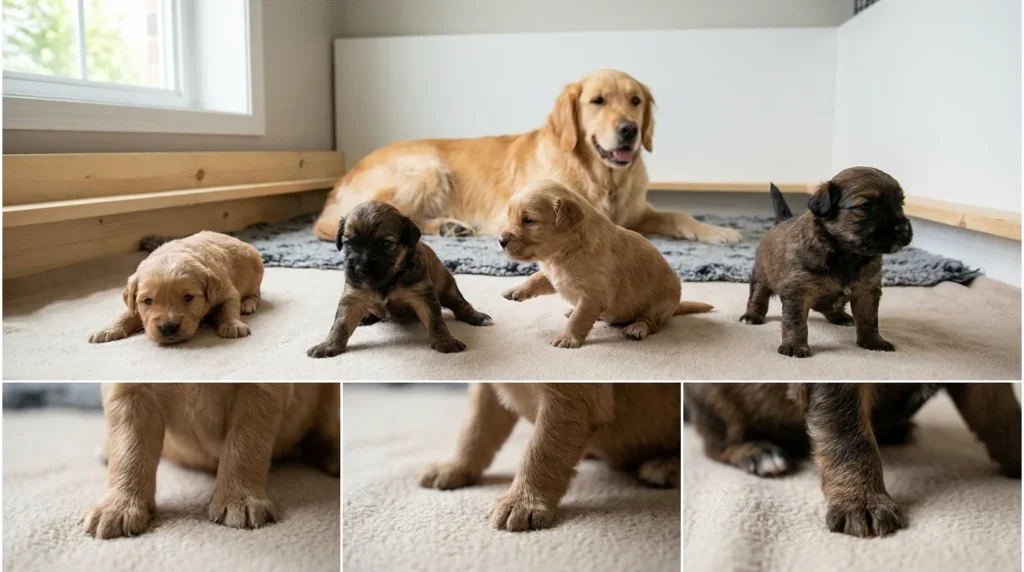
A missed milestone does not automatically identify a disease, but it deserves attention when progress is clearly behind the rest of development. VCA states that a four-week-old pup should be able to walk, run, and play, and warns that failure to meet basic milestones can signal a serious problem. A veterinarian can check for weakness, orthopedic abnormalities, neurological conditions, nutritional problems, or other causes.
Contact a veterinarian sooner if the pup cannot bear weight, seems painful, suddenly loses a skill it previously had, or has persistent weakness. Tremors, abnormal limb positioning, dragging a limb, trouble breathing, poor nursing, or failure to gain weight also warrant professional advice. VCA recommends urgent assessment when an animal cannot stand or walk without assistance, especially when trauma or severe pain is involved.
Veterinary care can become expensive when unexpected problems appear, especially during puppyhood. If you are planning ahead financially, ENF Blogs has a practical overview of whether pet insurance may be worth it. Insurance terms vary, so compare exclusions, waiting periods, deductibles, and coverage before choosing a policy.
First Steps Are Not the Same as First Outdoor Walks
Learning to walk inside a whelping area happens weeks before a young dog is ready for neighborhood walks. Physical ability is only one consideration because vaccination status, infectious-disease exposure, local parvovirus risk, and socialization also matter. U.S. owners should ask their veterinarian when ground-level exposure in public places is appropriate for their specific area.
AAHA advises owners to balance disease prevention with early socialization rather than isolating a young dog completely. Controlled experiences can include being carried outside, using a stroller, observing the environment from a clean blanket, or meeting healthy vaccinated dogs in appropriate private settings. Your veterinarian can adapt those choices to local disease risk and the individual vaccination schedule.
Public dog parks, heavily used pet areas, and places contaminated by unknown dogs require more caution. The AVMA recommends care around places where young animals gather until the vaccination series is complete. Physical readiness to walk does not equal immunological readiness for every public environment.
What Comes After the First Steps?
Weeks four through eight bring rapid gains in play, coordination, social interaction, and exploration. By the time most young dogs move to their new homes, basic walking is already well established and attention shifts toward house training, positive socialization, handling, and introductory leash skills. These later lessons should stay brief, positive, and age-appropriate.
Routine care also expands as the dog grows. Doodle owners, for example, can bookmark ENF Blogs’ Goldendoodle grooming and haircut guide for future coat maintenance. Whatever the breed, regular veterinary visits remain the best place to discuss growth, vaccines, nutrition, parasite prevention, and exercise.
Frequently Asked Questions
When do puppies start walking if one puppy is smaller than its littermates?
A smaller pup may develop on a slightly different schedule, so size alone does not tell you whether something is wrong. Look for continuing gains in strength, standing, and coordination rather than comparing every movement with larger littermates. Contact your veterinarian if the smaller pup is weak, losing weight, not nursing well, or failing to progress toward normal four-week mobility.
Is it normal for a three-week-old puppy to wobble?
Yes, some wobbling is expected when a young dog has only recently begun supporting its weight. Balance, muscle control, and the nervous system are still developing, so early steps often look wide, shaky, and inefficient. The gait should become steadier as the pup approaches four weeks and continues practicing naturally.
Should a four-week-old puppy be able to walk?
A healthy four-week-old should generally be able to walk and often starts to run and play as well. Both AKC and VCA place functional walking around this stage, although individual timing can vary slightly. If a four-week-old cannot stand or move normally, arrange a veterinary assessment rather than waiting several more weeks.
When can a puppy start going on walks outside?
There is no single U.S. age that is correct for every dog because vaccination schedules and local disease risks differ. Your veterinarian should tell you when public ground exposure is appropriate, while safe social experiences can often begin earlier through controlled methods. Carrying the pup, using clean private spaces, and avoiding unknown dogs can provide exposure without treating an unvaccinated youngster like an adult walking companion.
The Main Milestone to Watch
First steps are part of a fast developmental sequence, not a skill that appears on one exact birthday. Expect attempts to stand around the second or third week, early walking soon after, and much stronger mobility at roughly four weeks. If progress stalls, movement appears painful, or a pup cannot support itself, contact a veterinarian rather than trying to correct the problem at home.