
Trying to figure out a kitten’s age can feel surprisingly difficult when you do not know the birth date. Fortunately, kittens develop quickly during their first weeks, and changes in their eyes, ears, teeth, weight, movement, and eating habits provide useful clues. Looking at several of these signs together gives you a much better estimate than relying on size alone.
Quick answer: To estimate kitten age, compare several signs together: eyes and ears, baby teeth, body weight, coordination, and whether the kitten is nursing or eating solid food. Eyes open around two weeks, teeth begin appearing around three weeks, and an eight-week-old kitten is often near two pounds. A veterinarian can provide the most reliable estimate.
Kitten Age Chart: Development From Birth to 12 Weeks
The first three months contain some of the fastest changes in a cat’s life. A kitten that cannot stand or regulate body temperature at birth may be confidently running, climbing, eating kitten food, and using a litter box only several weeks later. The following kitten age chart gives practical ranges rather than exact birthdays because breed, nutrition, illness, birth weight, and individual growth can all affect development.
| Kitten age | Eyes and ears | Teeth and movement | Typical weight | Main care stage |
|---|---|---|---|---|
| Newborn | Eyes closed, ears folded | Toothless, cannot walk | About 1.8–5.3 oz | Mother’s milk or kitten formula |
| 1 week | Eyes usually still closed or beginning to open | Can lift head, limited movement | About 5.3–8.8 oz | Fully dependent on caregiver |
| 2 weeks | Eyes open and blue, ears unfolding | Wobbly first steps | About 8.8–12.3 oz | Milk or kitten formula |
| 3 weeks | Eyes open, ears becoming upright | Incisors appearing, walking improves | About 12.3–15.9 oz | Litter box and food exploration begins |
| 4 weeks | Vision improving, ears upright | Canines appearing, steadier walking | About 1 lb | Weaning can begin |
| 5 weeks | Eyes usually still blue | Premolars emerging, running and playing | About 1.2–1.4 lb | Wet kitten food becomes important |
| 6 weeks | Vision and hearing well developed | Baby teeth developing, highly active | About 1.4–1.7 lb | Mostly or fully eating kitten food |
| 7 weeks | Adult eye color may begin appearing | Baby teeth present, confident climbing | About 1.7–1.9 lb | Usually well into weaning |
| 8 weeks | Adult eye color may be visible | Coordinated, energetic and independent | About 1.9–2.1 lb | Eating independently |
| 9–12 weeks | Adult appearance becoming clearer | Strong coordination and active play | Varies increasingly | Socialization and preventive care |
Weight is helpful, but it should never be treated as an exact calendar. Best Friends Animal Society recommends considering weight alongside physical development, while veterinary references also use teeth, eye changes, movement, and feeding stage. A small but healthy kitten may simply grow differently from another kitten of the same age.
How to Tell a Kitten’s Age
The best way to estimate age at home is to work through several visible clues instead of searching for one perfect measurement. Start with the features that change on a relatively predictable schedule, especially the eyes, ears, teeth, walking ability, and feeding behavior. Then compare those clues with the kitten’s weight to narrow the estimate to a likely week or age range.
Check the Eyes and Ears
A newborn kitten normally has closed eyes and folded ears, which immediately suggests a very young age. Eyes begin opening during the early weeks and initially appear blue, while the ears gradually unfold and become upright. By later kittenhood, the eyes may begin changing toward the adult color, making eye color more useful when combined with teeth and coordination rather than used alone.
Blue eyes do not automatically mean a kitten belongs to a specific week because young kittens retain blue eyes for a period before their permanent color develops. Alley Cat Allies notes that adult eye color can begin emerging around seven weeks and should be clearer later in development. Some cats naturally retain blue eyes into adulthood, so eye color should always remain only one part of the estimate.
Look at the Teeth
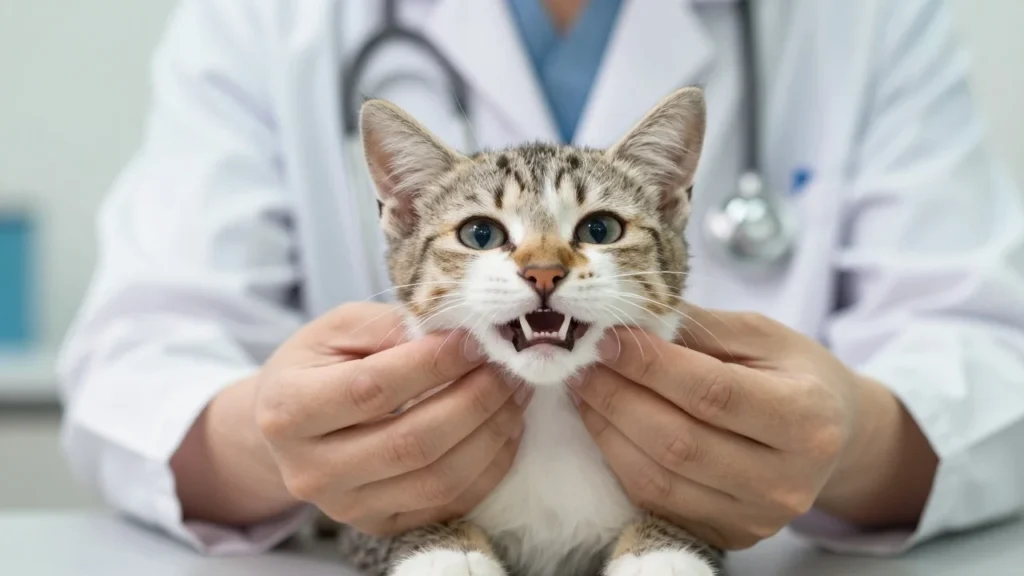
Teeth are among the most useful age clues once a kitten reaches roughly three weeks. The front incisors begin emerging first, followed by canine teeth and then premolars as the kitten continues developing. By around six to seven weeks, kittens generally have most or all of their deciduous, or baby, teeth.
Checking teeth is easier when the kitten is calm and comfortable. Do not force the mouth open or struggle with a frightened kitten simply to estimate its age, because a veterinarian or experienced rescue worker can perform the examination safely. Teeth are especially valuable when a kitten’s body size is misleading because of poor nutrition or an unusually small or large build.
Use Weight as a Supporting Clue
Healthy kittens often gain weight rapidly during early development, which is why rescues commonly use a small scale while estimating age. A kitten close to one pound may be around four weeks old, while one approaching two pounds is often close to eight weeks, although those figures are only general benchmarks. Breed, nutrition, parasites, illness, and birth size can all move a kitten above or below the expected range.
If you are caring for a young or orphaned kitten, tracking weight over time is more useful than taking one measurement. A consistent upward trend can provide useful information about growth, while weight loss or failure to gain deserves veterinary attention. PetMD advises contacting a veterinarian when a kitten is weak, losing weight, refusing food, or having difficulty breathing. Those early visits add up quickly, which is why many new owners weigh up whether pet insurance is worth it while their kitten is still small.
Watch How the Kitten Moves
Movement changes dramatically during the first several weeks. Very young kittens crawl or take unstable steps, while three-week-old kittens become steadier and four- to five-week-old kittens begin playing, climbing, running, and exploring much more confidently. By seven or eight weeks, most healthy kittens look coordinated and energetic even though they are still developing physically and behaviorally.
Behavior also gives clues about independence. A kitten that is still completely dependent on nursing is probably considerably younger than one confidently eating kitten food, grooming, using a litter box, and chasing toys around the room. These milestones overlap, however, which is another reason to compare several signs instead of treating one behavior as proof of age.
Kitten Development Week by Week
Newborn to 1 Week Old
Newborn kittens are completely dependent on their mother or a skilled caregiver. Their eyes are closed, their ears are folded, they have no teeth, and they cannot regulate body temperature or move around normally on their own. Alley Cat Allies notes that newborn kittens spend most of their time sleeping and eating during this highly vulnerable stage.
An orphaned newborn requires specialized care rather than ordinary cat food or cow’s milk. The ASPCA recommends a commercial kitten milk replacer when the mother cannot feed the kitten and advises contacting a veterinarian for feeding recommendations. Because very young kittens can deteriorate quickly, professional or experienced rescue support is especially valuable at this age.
2 Weeks Old
At about two weeks, the eyes are generally open and blue while the ears continue unfolding. The kitten begins taking small, unsteady steps and becomes more aware of smells, sounds, littermates, and the surrounding environment. Despite these changes, a two-week-old kitten still depends heavily on its mother or caregiver for warmth, food, and basic care.
This is an age when appearance can make a kitten seem more independent than it really is. Open eyes do not mean the kitten is ready for solid food or separation from its mother. Development is still in a neonatal phase, so age-appropriate care remains essential.
3 Weeks Old
Around three weeks, kittens begin looking noticeably more capable. Their ears are becoming upright, their walking improves, and the small incisors at the front of the mouth begin emerging. They may also begin showing interest in a shallow litter box and exploring food while remaining dependent on milk.
This stage is also important for social and behavioral development. Kittens begin interacting more actively with littermates, people, objects, and their environment, creating opportunities for gentle positive handling. Avoid overwhelming a young kitten with too many new experiences at once, because gradual exposure is more appropriate than forced interaction.
4 Weeks Old
A four-week-old kitten is usually much steadier on its feet and considerably more playful than it was only a week earlier. Canine teeth begin emerging, coordination improves, and interest in toys, litter, and food becomes much more obvious. This is also around the age when the gradual weaning process can begin.
The ASPCA explains that weaning normally begins at roughly four weeks and progresses gradually rather than happening overnight. Kittens benefit from remaining with their mother during this transition whenever possible because they continue learning eating, litter-box, play, and social behaviors from her. Most kittens are not completely finished with the process for several more weeks.
5 to 6 Weeks Old
Five- and six-week-old kittens are active, curious, and increasingly coordinated. Premolars are appearing, running becomes confident, grooming improves, and the kitten usually spends much more time playing with siblings, toys, and people. By this stage, kitten food is becoming a major part of the diet, while nursing may continue for comfort or additional nutrition.
Socialization is especially important during these weeks because young kittens are rapidly learning how to interact with people and other animals. Gentle handling, safe toys, scratching surfaces, and positive introductions can help build confidence. Alley Cat Allies identifies roughly two to eight weeks as a particularly important socialization window, making calm positive experiences valuable during this stage.
7 to 8 Weeks Old
Seven- and eight-week-old kittens usually look much more independent. They can run, climb, jump, groom, use the litter box, and eat kitten food without the constant assistance required during the neonatal period. Adult eye color may begin becoming apparent, and an eight-week-old kitten commonly weighs around two pounds, although healthy individuals can fall outside that estimate.
Eight weeks is also a major practical milestone in many U.S. shelters and rescue programs. Kittens are generally eating independently and are much better equipped to transition into adoptive homes, although policies about adoption and veterinary procedures vary among organizations. Best Friends Animal Society describes the eight-week mark as an important milestone for kittens growing toward adoption readiness.
9 to 12 Weeks Old
By nine weeks, kittens begin displaying many of the body-language patterns and everyday behaviors seen in adult cats. They are eating solid food, following more predictable sleep and activity patterns, and showing clear social preferences toward familiar caregivers. Their growth continues, but the week-to-week physical changes are less dramatic than during the first two months.
Play remains extremely important during this period because it supports physical coordination and appropriate social behavior. Offer safe toys that allow stalking, chasing, pouncing, and batting instead of encouraging the kitten to attack hands or feet. Positive handling can also help the kitten become more comfortable with grooming, nail care, carriers, and future veterinary visits.
What Happens From 3 to 6 Months?
Between three and six months, kittens begin looking less like tiny babies even though they remain firmly within the kitten stage. Energy levels can be intense, exploration increases, and play often becomes faster, stronger, and more athletic as the kitten builds muscle and coordination. This is also a useful period for reinforcing litter habits, scratching-post use, gentle handling, carrier comfort, and appropriate play.
Veterinary care becomes particularly important during these months because the initial kitten vaccination series continues through early life. Cornell explains that core vaccination commonly begins around six to eight weeks, with additional doses administered at intervals as the kitten grows and maternal antibodies decline. Rabies vaccination timing depends on the product used and applicable state or local requirements, so a veterinarian should create the schedule for the individual kitten.
What Happens From 6 to 12 Months?
A six-month-old kitten may already resemble a small adult cat, but physical and behavioral development is still underway. Playfulness, curiosity, and high energy remain common, while body proportions and muscle development continue changing during the rest of the first year. Nutrition should still be appropriate for growth unless a veterinarian recommends something different based on the individual kitten.
The ASPCA notes that kitten-formulated food is generally appropriate until maturity at around one year because growing cats have substantial energy and nutrient needs. Feeding recommendations can vary according to weight, body condition, activity, health, and the calorie density of the food, so package portions are only a starting point. A veterinarian can help adjust intake if a kitten is gaining too quickly, growing slowly, or developing digestive problems.
When Does a Kitten Become an Adult Cat?
Veterinary life-stage guidelines provide a clear answer even though a cat may begin looking adult several months earlier. The American Animal Hospital Association and American Association of Feline Practitioners classify the kitten stage as birth up to one year, followed by the young-adult stage from one through six years. That means a cat is generally considered to have moved beyond the formal kitten life stage at about its first birthday.
That cutoff should not be interpreted as an overnight biological change. Growth rate, maturity, personality, breed, and body size differ among cats, and some larger breeds can continue developing beyond their first birthday. The one-year point is most useful as a healthcare and life-stage framework rather than an exact moment when kitten behavior suddenly disappears.
Kitten Age in Human Years
Comparing a kitten’s age with human age is only an analogy, but it helps illustrate how quickly feline development occurs. AAHA’s feline life-stage materials estimate that a one-month-old kitten corresponds roughly to a one-year-old human, a three-month-old kitten to about four human years, six months to about ten years, and one year to about fifteen human years. These comparisons reflect developmental pace rather than literal biological equivalence.
| Cat age | Approximate human-age comparison |
|---|---|
| 1 month | 1 year |
| 3 months | 4 years |
| 6 months | 10 years |
| 1 year | 15 years |
The table makes one point especially clear: cats mature much faster during their first year than people do. A kitten that changes dramatically within only a few months is therefore developing at a normal feline pace rather than experiencing an unusually rapid transition. After kittenhood, the relationship between feline and human aging becomes less dramatic and follows a different pattern.
Veterinary Care at Different Kitten Ages
Age matters because preventive healthcare recommendations change as kittens grow. Cornell recommends beginning a kitten vaccination series at approximately six to eight weeks, while veterinary wellness visits can begin at a similar stage or sooner when illness or developmental concerns are present. Your veterinarian can also discuss parasite control, nutrition, testing, microchipping, reproductive surgery, and the vaccination schedule appropriate for your location and the kitten’s lifestyle.
For U.S. owners planning for veterinary expenses, it helps to understand how coverage works before the first large bill arrives. This guide to understanding pet insurance coverage explains common policy types, deductibles, exclusions, and waiting periods. More general animal-care content is available in the ENF Blogs Pets section.
What to Do If You Find Kittens Outside
Finding kittens outdoors does not automatically mean they have been abandoned. Their mother may be nearby searching for food, avoiding people, or waiting until the area feels safe enough to return, so animal-welfare organizations generally recommend observing healthy kittens from a distance before removing them. If the kittens are ill, injured, cold, weak, or clearly in danger, contact a veterinarian, rescue organization, or shelter for guidance.
Use age as one part of the decision rather than assuming every outdoor kitten needs the same intervention. The ASPCA notes that kittens around two months old generally eat independently, weigh about two pounds, and have good coordination when walking, running, and playing. Younger kittens may require much more specialized care if their mother truly does not return.
Before intervening, check:
- Whether the kittens appear sick or injured.
- Whether their eyes are open or closed.
- Whether they can walk, run, and play confidently.
- Whether they are clean, warm, and quiet or distressed and weak.
- Whether a mother cat returns when people move away.
- Whether a local rescue or veterinary clinic can advise you before you relocate them.
Frequently Asked Questions About Kitten Age
How can I tell how old my kitten is?
Start by checking the eyes, ears, teeth, body weight, coordination, and feeding stage. A veterinarian can usually narrow the estimate further through a physical examination, especially once teeth begin erupting. Combining several clues is more dependable than deciding age from weight or size alone.
How old is a 2-pound kitten?
A healthy kitten weighing around two pounds is commonly close to eight weeks old. The ASPCA uses approximately two pounds, independent eating, and good running and playing coordination as signs of a kitten around two months of age. Weight varies, however, so teeth, eyes, and behavior should confirm the estimate.
What age do kittens open their eyes?
Kittens are born with their eyes closed, and they begin opening them during the early weeks of life. By approximately two weeks, the eyes are usually open and appear blue, although individual timing varies. Never force a kitten’s eyelids open because normal development should occur naturally.
What age do kittens start eating food?
The transition from milk toward kitten food generally begins at about four weeks. The ASPCA recommends a gradual weaning process and notes that most kittens complete the transition around eight to ten weeks, although they may start experimenting with food much earlier. Sudden separation from the mother should be avoided whenever she is healthy and caring for the litter.
How old is a kitten when its eyes change color?
Young kittens commonly begin life with blue eyes, and their permanent color develops later. Alley Cat Allies notes that adult eye color may begin emerging around seven weeks and should become more apparent during the following weeks. Eye color alone is not a precise age test because genetics and individual development vary.
Is an 8-week-old cat still a kitten?
Yes, an eight-week-old cat is still very much a kitten even though it can usually eat, play, run, groom, and use a litter box independently. AAHA and AAFP life-stage guidelines define kittenhood as birth up to one year. An eight-week-old kitten has therefore reached an important independence milestone, not adulthood.
The Best Way to Estimate Kitten Age
Determining kitten age is easiest when you combine physical development with behavior rather than relying on one number. Eyes, ears, teeth, weight, movement, eating habits, litter-box use, and coordination create a much clearer picture when considered together. During the first eight weeks, these changes happen quickly enough that you can often narrow an unknown kitten’s age to a fairly small range.
Once you have a reasonable estimate, use it to choose appropriate food, socialization, veterinary care, and supervision rather than treating the estimate as an exact birthday. Very young, weak, injured, cold, non-eating, or poorly growing kittens should be evaluated by a veterinarian or experienced rescue professional. A good age estimate is useful, but getting the kitten the right care at the right stage matters much more.