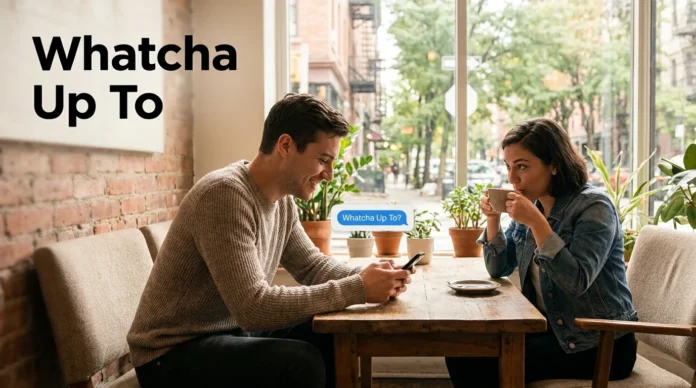
Someone sends you “whatcha up to?”, and suddenly, a simple three-word message can feel surprisingly open to interpretation. The phrase usually asks what you are doing, but its exact tone can change depending on who sent it, when they sent it, and the relationship you have with that person. A friend may simply be starting a conversation, while a crush may be checking whether you are free to talk or meet up.
Quick answer: “Whatcha up to?” is an informal way of saying “What are you up to?” and usually means “What are you doing?” It can be a casual greeting, a way to check whether you are busy, or an opening to make plans. In some conversations, it can also sound mildly flirty.
What Does “Whatcha Up To” Mean?
Whatcha up to generally means “What are you doing?” or “What are you doing right now?” The person asking may genuinely want to know about your current activity, but they may also be using the question simply to start a conversation. In casual English, “What are you up to?” can even function as a friendly greeting when neither person expects a detailed answer.
For example, someone who texts you in the evening may be asking whether you are busy because they want to chat, call, or suggest meeting up. If a friend sends the message during the day, they may simply be checking in and looking for something to talk about. The words themselves do not reveal the sender’s full intention, so the surrounding conversation matters more than the phrase alone.
Is “Whatcha” a Real Word?
“Whatcha” is a highly informal contraction or pronunciation-based spelling used in casual speech and writing. In the expression “whatcha up to,” it represents the way “what are you” can sound when people speak quickly, turning “What are you up to?” into something closer to “Whatcha up to?” It is best understood as colloquial English rather than standard formal writing.
That does not mean people should never write it. “Whatcha” is perfectly understandable in text messages, private messages, social media conversations, dialogue, and other relaxed situations where informal language suits the relationship. For business emails, academic writing, job applications, or communication with someone you don’t know well, “What are you up to?” or a more specific question is usually the better choice. More from us: PSA Meaning in Text.
What Does “Whatcha Up To” Mean in a Text?
In texting, the most common interpretation is simply “What are you doing?” However, people often send it because they want more than a factual description of your current activity; they may be checking whether you are available for a conversation or an invitation. In many cases, “What are you up to?” carries the practical subtext of “Are you busy?” or “Do you have time to talk?”
Imagine that someone texts “whatcha up to?” at 8 p.m. Your answer, “Just watching a movie,” tells them both what you are doing and whether you might be free to continue talking. If they respond with “Want to grab something to eat?” it becomes clear that the original question was partly about checking your availability.
Common Intentions Behind the Text
| Possible intention | What the sender may really be asking |
| Casual check-in | “How are things going?” |
| Conversation starter | “Do you want to talk?” |
| Checking availability | “Are you busy right now?” |
| Making plans | “Are you free to hang out?” |
| Showing interest | “I wanted an excuse to message you.” |
| Flirting | “Are you free, and can I keep your attention?” |
Is “Whatcha Up To” Flirty?
It can be flirty, but it is not automatically a flirty message. Friends and family use the same question without any romantic intention, while someone interested in you may use it as an easy, low-pressure way to start a conversation. Your relationship, the timing of the message, previous conversations, emojis, follow-up questions, and whether the person repeatedly looks for reasons to talk are much stronger clues than the phrase itself.
For example, “Whatcha up to? ” from someone you have been flirting with carries a different feeling from “Whatcha up to? We still meeting at 6?” from a friend. A late-night message from a crush may also feel more suggestive than the same text from a sibling at lunchtime. Context should guide your interpretation instead of assuming everyone who asks is romantically interested.
30 Natural Replies to “Whatcha Up To?”

You do not need a clever response every time someone sends this message. A good reply usually answers the question at least briefly and, if you want the conversation to continue, gives the other person something to respond to. Returning the question with “you?” or “how about you?” is one of the easiest ways to keep the exchange moving naturally.
| Situation | Reply |
| Casual | “Not much, just relaxing. You?” |
| Casual | “Just hanging out at home. What about you?” |
| Casual | “Nothing exciting. What are you up to?” |
| Casual | “Just taking it easy today.” |
| Casual | “A little bit of this and that. You?” |
| Friendly | “Just watching a movie. How about you?” |
| Friendly | “Making dinner right now. What’s going on?” |
| Friendly | “Just finished some work. What about you?” |
| Friendly | “Catching up on a few things. How’s your day going?” |
| Friendly | “Just scrolling on my phone, honestly. You?” |
| Interested | “Not much. Did you have something in mind?” |
| Interested | “I’m free at the moment. What’s up?” |
| Interested | “Just relaxing. Were you thinking of doing something?” |
| Interested | “Nothing I can’t pause. What are you doing?” |
| Interested | “I was looking for something fun to do, actually.” |
| Flirty | “Waiting for you to text me, apparently.” |
| Flirty | “Nothing interesting yet. Planning to change that?” |
| Flirty | “Depends. Are you about to make me an offer?” |
| Flirty | “Just wondering when you were going to message me.” |
| Flirty | “Not much. Are you trying to steal my evening?” |
| Cute | “Trying to decide what snack I deserve.” |
| Cute | “Being extremely productive at doing absolutely nothing.” |
| Cute | “Currently accepting entertaining suggestions.” |
| Cute | “Pretending I have plans. How about you?” |
| Cute | “Just surviving the day one coffee at a time.” |
| Busy | “Working right now, but I’ll be free later.” |
| Busy | “A little tied up at the moment. Can I text you afterward?” |
| Busy | “Finishing something for work, but what’s up?” |
| Polite | “Just taking care of a few things. How about you?” |
| Short | “Not much, you?” |
How to Reply When Your Crush Says “Whatcha Up To?”
When a crush sends that message, your best response depends on whether you want to keep the conversation going. If you are interested, give them more than a closed answer such as “nothing” by adding a question or a playful opening they can respond to. Something like “Just relaxing—did you have something fun in mind?” shows interest without making the conversation unnecessarily intense.
If you are unsure about their intentions, a neutral reply works equally well. “Just watching TV, you?” gives them an opportunity to reveal why they messaged without forcing you to assume that the conversation is romantic. Their next response will usually tell you much more than their first “whatcha up to?” message.
What If a Guy Says “Whatcha Up To?”
When a guy asks “whatcha up to?”, he may simply be curious about what you are doing, trying to start a conversation, checking whether you are available, or looking for an opportunity to make plans. The phrase by itself does not prove attraction because it is widely used in casual conversation. If he follows it with personal questions, playful comments, an invitation, or repeated attempts to keep the conversation going, those additional signals provide more context.
If you like him, respond in a way that leaves the conversation open instead of trying to decode the entire relationship from three words. You might say, “Not much, just relaxing. What are you up to?” A simple response gives him room to reveal whether he wants to chat, make plans, or flirt.
What If a Girl Says “Whatcha Up To?”
The meaning does not fundamentally change when a girl sends the message. She may be checking in as a friend, starting a casual conversation, seeing whether you are available, or showing interest, depending on your relationship and the surrounding messages. Trying to assign a universal romantic meaning based solely on the sender’s gender is less useful than looking at how she continues the conversation.
If you want to talk to her, answer the question and return some conversational energy. A response such as “Just finished dinner and finally relaxing. How’s your evening going?” gives the conversation an easy way to continue. If she was hoping to make plans or flirt, her follow-up will usually make that clearer.
“Whatcha Up To?” vs. Similar Expressions
Several everyday English expressions look similar but ask slightly different things. Choosing between them depends mainly on whether you want to ask about the current moment, someone’s recent life, or simply greet them. Understanding those differences can also help you respond more naturally when you receive one of these messages.
| Expression | Typical meaning | Common use |
| Whatcha up to? | What are you doing? | Very casual speech or texting |
| What are you up to? | What are you doing? | Casual conversation |
| What’s up? | How are things?/What’s happening? | Greeting or conversation starter |
| What have you been up to? | What have you been doing recently? | Catching up after some time apart |
| What are you doing tonight? | What are your plans tonight? | Asking about a specific time |
| Are you busy? | Are you available right now? | Direct availability check |
“What have you been up to?” deserves particular attention because it usually asks about a longer period rather than only the present moment. Someone you have not spoken to recently might use it to ask what has been happening in your life, such as work, school, relationships, travel, or other recent changes. By comparison, “whatcha up to?” more naturally focuses on what you are doing now or what you are about to do.
Is “Whatcha Up To” the Same as “What’s Up?”
The two expressions overlap, but they are not exactly the same. “What’s up?” commonly functions as an informal greeting and may be answered with “Not much,” while “whatcha up to?” more directly asks what someone is doing. Even so, both phrases are often used casually to begin a conversation.
In everyday conversations, people often use both expressions loosely. A friend saying “whatcha up to?” may not expect a detailed account of your activities any more than someone saying “what’s up?” expects a major life update. Short answers such as “not much” therefore sound natural with either expression.
Is “Whatcha Up To” Rude?
The phrase is not usually rude between friends, relatives, partners, or people who already communicate casually. Its relaxed spelling can even make a message sound more familiar and conversational. Problems arise mainly when the level of informality does not fit the situation, such as when writing to a client, professor, interviewer, or unfamiliar professional contact.
Tone also matters because “What are you up to?” can occasionally sound suspicious rather than friendly. A parent who discovers a child hiding something might ask, “What are you up to?” with the implied meaning, “What are you secretly doing?” In ordinary texting, however, the friendlier interpretation is usually more likely unless the surrounding context suggests suspicion.
When Should You Use “Whatcha Up To?”
Use it when your relationship with the other person comfortably allows casual language. It works naturally in texts between friends, messages to someone you are dating, relaxed group chats, and spoken conversations where contractions and informal pronunciation are normal. Because “whatcha” reflects very casual speech, standard forms are safer whenever professionalism, clarity, or formality matters.
The easiest rule is to match the language you already use with that person. If you regularly write “gonna,” “wanna,” use emojis, abbreviations, and conversational spellings, “whatcha up to?” probably will not feel unusual. If your messages normally begin with “Hello” and contain complete, formal sentences, “What are you doing?” or a more specific question will sound more appropriate.
How to Keep the Conversation Going
If you want the conversation to continue, avoid answers that leave the other person nowhere to go. “Nothing” technically answers the question, but “Not much, just deciding what to watch. Got any recommendations?” provides a natural next topic. Adding a small detail, asking the question back, or responding to the likely intention behind the message can turn a basic check-in into a real conversation.
You can also respond differently depending on your availability. When you are free, “Not much—what’s up?” makes that clear without overexplaining, while “Working right now, but I’ll be free around eight” communicates a boundary and leaves open the possibility of talking later. The best answer is therefore not a memorized line but one that accurately reflects what you want from the conversation.
Related Reading on ENF Blogs
Readers interested in how unusual expressions acquire meaning can also explore ENF Blogs’ guide to What Does Tralalero Tralala Mean? That article looks at another phrase whose meaning depends heavily on how and where it is used. Exploring expressions in context is often more useful than treating every informal phrase as though it has only one fixed dictionary definition. Also worth reading: Definition of Surreal.
Final Thoughts
“Whatcha up to?” is one of those casual messages that can seem more mysterious than it actually is. Most of the time, it simply means “What are you doing?”, although the sender may also be asking whether you are available to talk, make plans, or spend time together. A flirty interpretation is possible, especially when the message comes from a crush or romantic interest, but context and follow-up behavior matter much more than the phrase itself.
When replying, match both the sender’s tone and your own level of interest. A simple “Not much, you?” works in almost any casual situation, while a playful response can encourage flirting and a direct answer can make it clear that you are busy. Once you understand the phrase as a flexible conversation opener rather than a secret code, responding becomes much easier.
Frequently Asked Questions
What does “whatcha up to?” mean from a friend?
From a friend, it usually means “What are you doing?” or “What’s going on?” They may be checking in, looking for someone to talk to, or trying to see whether you are free to make plans. Unless the rest of the conversation suggests otherwise, there is usually no need to search for a hidden meaning.
Does “whatcha up to?” mean someone likes you?
Not necessarily. The phrase is commonly used among friends and people with no romantic relationship, so receiving it alone doesn’t indicate attraction. If it is combined with frequent messages, flirting, compliments, invitations, or obvious efforts to spend time with you, those behaviors may provide stronger evidence of interest.
What is the best reply to “whatcha up to?”
A flexible response is “Not much, you?” because it answers the question and gives the sender an easy way to keep the conversation going. If you are doing something interesting, mentioning it can create a better exchange, such as “Just making dinner—what are you doing?” If you suspect the person wants to make plans, “Not much, did you have something in mind?” is especially useful.
Can I say “whatcha up to?” at work?
You can use it with coworkers you know well when the conversation is clearly informal. It is less appropriate in formal emails, client communications, interviews, or messages to senior colleagues when you would normally use standard written English. In those situations, “What are you working on?” or “Are you available?” communicates your purpose more clearly.
Is “whatcha up to?” grammatically correct?
It represents informal spoken English rather than the standard written form of the question. “What are you up to?” is the conventional version, while “whatcha” imitates the reduced pronunciation people often use when speaking quickly. That makes it suitable for casual dialogue and texting but generally unsuitable for formal writing.