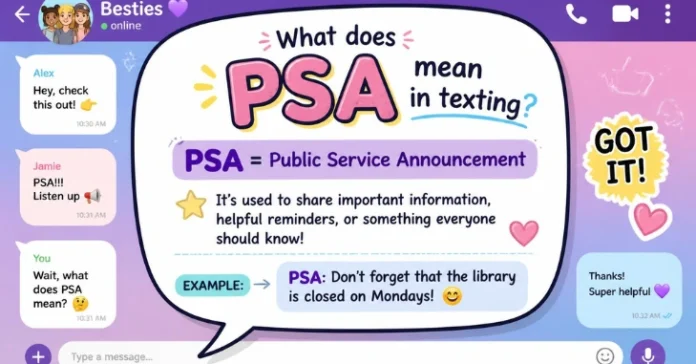
PSA in text usually means “Public Service Announcement.” In everyday messages, it signals that the sender is about to share something important, useful, funny, or worth noticing. Think of it as a “quick heads-up” or “something everyone should know” rather than a literal government or broadcast announcement.
If you searched for “psa meaning in text,” you probably saw these three letters at the beginning of a message, caption, comment, or group chat post. PSA may sound formal, but its online use is often surprisingly casual and can introduce anything from a genuine warning to a joke about coffee. The words that follow PSA usually tell you whether the sender is being serious, helpful, sarcastic, or playful.
Understanding the abbreviation is especially useful because the same three letters can have completely different meanings in medicine and collectibles. In ordinary texts and social media conversations, however, “public service announcement” is the meaning you should consider first. This guide explains how PSA is used, how to recognize its tone, and how to respond without overthinking the message.
What Does PSA Mean in Text? Understanding the PSA Meaning
In texting, PSA stands for Public Service Announcement and usually introduces information that the sender wants people to notice. Merriam-Webster recognizes “public service announcement” as one meaning of the abbreviation, while modern messaging has extended the phrase into a more informal attention-grabber. Instead of announcing an official public campaign, someone might simply write, “PSA: We’re leaving at 7, not 8.”
The easiest way to understand PSA is to translate it as “important note,” “quick heads-up,” or “something everyone should know.” A sender may use PSA for a schedule change, warning, helpful tip, strong opinion, or funny observation. The abbreviation itself does not automatically indicate urgency, so the rest of the message determines how seriously you should take it.
Why Do People Use PSA Meaning?
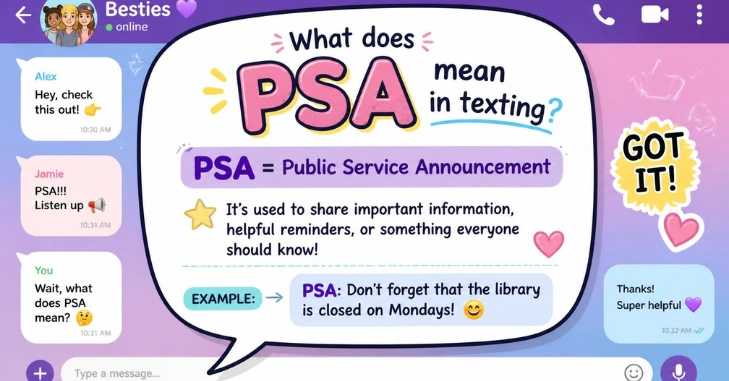
PSA meaning in text makes a message stand out before the reader even reaches the main point. In a busy group chat or social media feed, those three capital letters suggest that the next sentence deserves extra attention. The expression can therefore make an ordinary reminder more noticeable without requiring a long introduction.
People also use PSA because its formal wording can create humor when the subject is trivial. Saying, “PSA: The leftover pizza is mine,” treats a personal preference as though it were important public information. That exaggerated seriousness is one reason PSA works naturally in memes, captions, comments, and casual conversations.
15 PSA Examples and What They Mean
The meaning becomes much easier to understand when you see PSA used in realistic conversations. These examples show how the same abbreviation can introduce reminders, warnings, advice, updates, jokes, and opinions. The message after the colon usually provides most of the emotional context.
| PSA Example | What the Sender Means | Likely Tone |
| “PSA: The meeting starts at 9 tomorrow.” | Remember the changed time. | Informative |
| “PSA: Bring an umbrella tonight.” | The weather may be bad. | Helpful |
| “PSA: Don’t click that link in the group chat.” | There may be a security risk. | Serious |
| “PSA: The store closes early today.” | Plan your visit accordingly. | Practical |
| “PSA: Save your work before updating.” | Avoid losing your progress. | Helpful |
| “PSA: We’re out of milk.” | Someone needs to buy more. | Casual |
| “PSA: Drink some water today.” | A friendly reminder to stay hydrated. | Caring |
| “PSA: The assignment is due Friday, not Monday.” | Correcting a misunderstanding. | Informative |
| “PSA: Nobody looks good before their first coffee.” | This is a joke or observation. | Humorous |
| “PSA: Pineapple belongs on pizza.” | A strong personal opinion. | Playful |
| “PSA: Please stop spoiling new episodes.” | The sender is annoyed. | Frustrated |
| “PSA: You can say no without writing an essay.” | General life advice. | Supportive |
| “PSA: The parking lot is full.” | Look for another place to park. | Practical |
| “PSA: Screenshots exist.” | Be careful about what you send. | Warning or joking |
| “PSA: Mondays are still terrible.” | A deliberately obvious statement. | Sarcastic |
Is PSA Serious, Funny, or Sarcastic?
PSA can sound serious when it introduces a warning, safety issue, deadline, or important update. A message such as “PSA: The road outside the school is closed” is probably intended to help people make a practical decision. In that situation, the abbreviation adds emphasis rather than humor.
The same expression can sound playful when the announcement is obviously not a matter of public importance. “PSA: Fries taste better when someone else ordered them” uses an official-sounding abbreviation to exaggerate a silly opinion. This humorous use is common because the contrast between the formal introduction and the casual statement creates the joke.
PSA can also sound sarcastic or passive-aggressive depending on the wording that follows it. A message such as “PSA: Some people actually answer their texts” may be aimed at a particular person, even though it is phrased like a general announcement. When the statement sounds critical or unusually pointed, the context and your relationship with the sender matter more than the abbreviation itself.
What Does PSA Mean on TikTok, Instagram, and Snapchat?
On TikTok, Instagram, Snapchat, and similar platforms, PSA normally keeps the same basic meaning: Public Service Announcement. Creators use it in captions, videos, Stories, comments, and on-screen text to introduce a tip, warning, reminder, opinion, or message they want followers to notice. The term can sound serious, humorous, or sarcastic depending on the content that follows it.
The platform does not usually change the definition, but it can change the style of the message. A TikTok creator might use “PSA” before sharing a quick life hack, while an Instagram user might place it before a personal opinion or reminder. If you are interested in how platform features influence online interactions more broadly, ENF Blogs also examines how hidden likes are changing Instagram.
Is PSA Actually Slang?
PSA is technically an abbreviation rather than a slang word because the letters come directly from “Public Service Announcement.” However, its modern conversational use has become informal enough that people commonly search for it as texting or internet slang. In casual communication, the traditional phrase has effectively become shorthand for “listen up” or “here’s something worth knowing.”
That distinction matters mainly when you are writing formally. In texts, social media posts, and friendly group chats, using PSA casually is widely understood. In a formal report or professional document, spelling out “public service announcement” may be clearer unless the abbreviation has already been defined.
PSA vs. FYI vs. “Heads-Up”
PSA, FYI, and “heads-up” can all introduce information, but they do not create exactly the same effect. PSA is usually the most attention-grabbing because it frames the information as something a wider group should notice. FYI feels more neutral, while “heads-up” often suggests that the information will help someone prepare for what is coming.
| Expression | Basic Meaning | Typical Effect | Example |
| PSA | Public Service Announcement | Emphasizes a message for everyone | “PSA: Doors close at 8.” |
| FYI | For Your Information | Shares information neutrally | “FYI, Sam already emailed the file.” |
| Heads-up | Advance notice | Helps someone prepare | “Heads-up, traffic is heavy downtown.” |
Choosing among them depends mostly on tone. Use PSA when you deliberately want the message to feel like an announcement, especially in a group or public post. Use FYI for straightforward information and “heads-up” when you want to warn someone about something they may soon encounter.
How Should You Reply When Someone Says PSA?
You usually respond to the information that follows PSA rather than to the abbreviation itself. If the message contains a genuine update or warning, a short acknowledgment such as “Thanks for letting me know,” “Got it,” or “Good catch” is usually enough. If the PSA is obviously a joke, you can respond with a reaction, emoji, or playful comment that matches the sender’s tone.
Not every PSA requires a reply, particularly when it appears in a large group chat or public post. A message addressed to everyone may simply be intended to spread information rather than start individual conversations. However, when the sender asks you to take action, acknowledging the request can help prevent confusion.
Can PSA Mean Something Else?
Yes, and this is where context becomes especially important. “Public Service Announcement” is the most likely meaning in ordinary texting, but PSA is also an established abbreviation in medicine and the collectibles industry. Words such as “blood,” “test,” “prostate,” “card,” “grade,” or “PSA 10” immediately point toward a different interpretation.
| Context | PSA Meaning | How to Recognize It |
| Texting and social media | Public Service Announcement | Appears before a reminder, warning, tip, joke, or opinion |
| Medicine | Prostate-specific antigen | Appears with blood tests, prostate health, screening, or medical results |
| Trading cards and collectibles | Professional Sports Authenticator | Appears with card grading, authentication, or grades such as PSA 9 and PSA 10 |
In medicine, the National Cancer Institute defines PSA as prostate-specific antigen, a protein made by the prostate gland that can be measured in the blood. A “PSA test” therefore has nothing to do with texting or public announcements. Anyone reading medical results should interpret the abbreviation within that healthcare context rather than applying its social media meaning.
Among sports card and collectible enthusiasts, PSA commonly refers to Professional Sports Authenticator. Collectors often pair the abbreviation with a grading scale, resulting in terms such as “PSA 8,” “PSA 9,” and “PSA 10.” If the conversation involves Pokémon cards, sports cards, authentication, condition, or collectible values, this is probably the intended meaning.
How Can You Tell Which PSA Meaning Is Intended?
Start by reading the words immediately surrounding the abbreviation instead of interpreting PSA by itself. If it appears at the beginning of an everyday sentence followed by a colon, “Public Service Announcement” is usually the strongest interpretation. If it appears as a medical measurement or beside a collectible grade, one of the specialized definitions is much more likely.
The audience can provide another useful clue. Friends in a group chat are probably using PSA conversationally, while a doctor, laboratory report, or card collector may be using a technical meaning. Context solves most acronym confusion faster than trying to memorize every possible definition.
Looking at the surrounding conversation, platform, and subject is usually the most reliable way to understand unfamiliar online expressions. That approach works for PSA as well as for many other abbreviations and viral phrases. Instead of interpreting the letters in isolation, focus on what the sender is talking about and where the message appears.
Common Mistakes When Using PSA
One common mistake is assuming that putting “PSA” before a sentence automatically makes the information official. In online conversations, people routinely use the expression for opinions, jokes, and personal reminders that have nothing to do with an actual public campaign. Readers should therefore evaluate the statement itself rather than treating “PSA” as proof that a claim is authoritative.
Another mistake is using the abbreviation in situations where the audience may not know what it means. A casual social media audience will often understand it immediately, but highly formal or international communication may benefit from clearer wording. When clarity matters more than style, phrases such as “important notice,” “reminder,” or “please note” can communicate the same idea without requiring anyone to decode an acronym.
The Bottom Line
The PSA meaning in text is usually “Public Service Announcement,” but the phrase is much less formal online than its full name suggests. People use it to highlight warnings, reminders, useful information, personal opinions, sarcastic observations, and jokes that they want others to notice. When you see “PSA:” at the beginning of a message, the simplest translation is usually, “Pay attention—here’s something I think you should know.”
Context remains important when those letters appear somewhere else. A medical discussion may use PSA to mean prostate-specific antigen, while collectors use it to refer to Professional Sports Authenticator and card grades. Check the surrounding words first, and you can usually identify the intended meaning within seconds.
Frequently Asked Questions
What does PSA mean in texting?
PSA usually means “public service announcement” in texting. It tells readers that the sender wants to highlight a reminder, warning, useful fact, announcement, or opinion. The message may be serious or playful depending on what follows the abbreviation.
What does PSA mean from a girl?
PSA does not have a special romantic or gender-specific meaning when a girl uses it. In an ordinary message, it still most likely means “public service announcement” and introduces something she wants you or a group to notice. Read the rest of the message for clues about whether she is joking, warning you, giving advice, or making a point.
What does PSA mean from a guy?
There is no separate PSA, meaning when a guy sends it. It normally carries the same Public Service Announcement meaning used throughout texting and social media. Any flirting, irritation, humor, or seriousness comes from the surrounding message rather than from the three-letter abbreviation.
What does “quick PSA” mean?
“Quick PSA” means the sender wants to make a brief announcement or call attention to something before moving on. It is similar to saying “quick reminder,” “just a heads-up,” or “one thing everyone should know.” The phrase often makes a casual message sound slightly more important or dramatic.
What does PSA mean on Snapchat?
On Snapchat, PSA normally means Public Service Announcement. Someone may use it before a reminder, warning, opinion, joke, or short piece of advice sent through a Snap, Story, or chat. Snapchat does not give the abbreviation a separate standard meaning from the one commonly used on other social media platforms.
What does PSA mean on TikTok?
On TikTok, PSA usually introduces a point that the creator wants viewers to notice. It can appear before useful information, a warning, an opinion, a correction, or a deliberately exaggerated joke. The meaning remains a public service announcement even though the content itself may be completely informal.
Should PSA be written in capital letters?
PSA is traditionally written in capital letters because it is formed from the initial letters of “public service announcement.” People may still type “psa” in lowercase in informal texts without changing the intended meaning. Capital letters simply make the abbreviation stand out more clearly.
Does PSA always need a colon after it?
A colon is common because PSA often functions as an introduction to the announcement that follows. You may therefore see constructions such as “PSA: Check the schedule before leaving.” Casual messages sometimes omit the colon, and the abbreviation remains understandable from context.