
A settlement offer lands in your mailbox. One line on it says pain and suffering, and that line prices the part of the crash no receipt covers. Your sleep is wrecked, you quit the hobby, you flinch now at green lights. Nobody bills for any of that, so both sides argue the figure instead of adding it up.
Here is how it gets calculated, worked in dollars on one rear-end wreck, plus the limits that shrink this claim.
The short answer
Pain-and-suffering damages compensate you for the harm you feel rather than the money you spent. Insurers price them two ways. Either a multiplier applied to your medical bills, usually 1.5 to 5, or a daily rate times the days you hurt. Your records and your state’s rules decide which number sticks.
| Type of damages | What it covers | How you prove it | Taxable? |
|---|---|---|---|
| Economic | Medical bills, lost wages, future care | Receipts, pay stubs | Generally no, if tied to a physical injury |
| Non-economic damages | Pain, mental anguish, lost enjoyment, disfigurement, consortium | Records, testimony, a journal | Generally no, if tied to a physical injury |
| Punitive | Punishment for reckless conduct | Clear and convincing evidence | Yes, always |
Key takeaways
- These damages cover pain, mental anguish, lost enjoyment, disfigurement, and consortium.
- Two methods dominate. Multiply the medical bills by 1.5 to 5, or set a daily rate and count days.
- Imaging, surgery and permanent restrictions raise the multiplier. Treatment gaps lower it.
- Caps mostly bite in medical malpractice, and no-fault states can block the claim outright.
- Money for a physical injury is usually tax-free, but interest and punitive damages are not.
What this part of the claim pays for

Lawyers and adjusters call these non-economic damages because no ledger sits behind them. Five categories recur almost everywhere.
- Physical pain. The ache, the burning nerve, the weeks after surgery.
- Mental anguish. Anxiety, depression, panic behind the wheel, nightmares.
- Loss of enjoyment of life. What you did before and cannot do now, from playing catch to sleeping through the night.
- Disfigurement. Scars, burns, a limp strangers notice.
- Loss of consortium. Your spouse’s claim for lost companionship.
Loss of enjoyment is the hardest to price. It is also the easiest for an insurer to underplay. Juries grasp it best through a life they can picture, which is why the story behind Derrick Thomas’s death after a car crash still lands. An All-Pro linebacker, paralyzed on an icy highway, dead 16 days later at 33.
How it differs from economic and punitive damages
Physical pain follows the injury. Mental anguish follows the experience, and it can outlast the fracture by years. Many states compensate emotional harm only when a physical injury came with it, which is why insurers fight so hard over that link.
Economic damages are the provable dollars: bills, wages, the car. Punitive damages are a different animal. They punish the defendant rather than repay you, and they require conduct well past ordinary carelessness. Drunk driving qualifies. A fender bender does not.
Two ways to put a dollar figure on pain and suffering
Neither sits in a statute. Both are conventions that give each side something to argue over.
The multiplier method
Total your injury-related medical bills, then multiply. The realistic band runs from 1.5 to 5, and where you land is a judgment call.
- 1.5 to 2. Soft-tissue strain that clears up in weeks, nothing on the imaging.
- 2.5 to 3. An injury confirmed on an MRI, months of treatment, full recovery.
- 4 to 5. Surgery, hardware, permanent restrictions, visible scarring.
Anything above 5 is rare. An injury visible on imaging beats one you only report, and so does an operation or a doctor willing to write down permanent limits. Undisputed liability helps. Treatment breaks drag the factor down, as does degeneration already sitting in the same disc.
The per diem method
Pick a daily rate, then multiply by the days you hurt. Most people defend the rate with their own wage. If a day of your work is worth a set amount, the argument runs, a day of pain is worth as much. That suits an injury with an end date. It falls apart on a permanent one.
A worked example: one crash, both methods
Take a driver rear-ended at a stoplight, left with a herniated disc and four months of care.
- Add the medical bills. Emergency room and imaging: $4,200. Orthopedic visits and an epidural injection: $6,800. Twenty-four physical therapy sessions: $5,000. Medical total: $16,000.
- Add the other losses. Three weeks off work at $925 a week is $2,775, plus $400 in co-pays. Economic total: $19,175.
- Run the multiplier. The disc shows on the MRI, and fault is undisputed. At 2.5, $16,000 x 2.5 is $40,000.
- Bracket it. At 1.5, the figure is $24,000. At 3.5, it is $56,000. That spread is the negotiation.
- Run the daily rate. A $46,250 salary across 250 working days is $185 a day. Crash to final therapy is 130 days. 130 x $185 is $24,050.
- Reconcile them. The daily rate lands near the bracket’s bottom, so $24,000 reads as a floor. An attorney would demand near the top and expect around $30,000 to $45,000.
Add the economic total back, and the claim sits between $49,000 and $64,000. Those numbers belong to an invented case. Change the state, or one doctor’s wording, and the same injury moves tens of thousands either way. No calculator can tell you what your own claim is worth.
What evidence moves the number
You cannot hand an adjuster your headache. What you can hand over is a paper trail so consistent that discounting it starts to look unreasonable.
- Medical records. A chart note reading “patient reports 7 out of 10 pain radiating into the left hand” outweighs any discharge summary.
- A pain journal. Three or four short entries a week beat a daily essay. A useful entry contains the date, a 0 to 10 score, one activity you skipped, medication, and hours slept. Start today, because one written later reads like it.
- Treatment gaps. A three-week break in physical therapy is the cheapest argument the other side gets. An adjuster reads it as recovery and stops the daily rate clock.
- Witnesses and experts. A coworker describing what you used to lift lands harder than your own account, and your physician settles permanency.
Photos date an injury in a way sentences cannot. Shoot the bruising weekly, the scar at six months, and the car before it goes to salvage. Vehicle photos matter more than people expect. Heavy metal hides force, and a coupe like the 2010 Dodge Challenger SRT8 can absorb a hit that barely marks a fender.
The limits: caps on non-economic damages
Most states set no cap on non-economic damages in ordinary negligence. A car crash, a fall in a store: no ceiling. Caps bite hardest in medical malpractice, and the current figures are rarely the numbers older articles quote. California’s cap stands at $470,000 in 2026 for a non-death case, and $650,000 for wrongful death. Both climb each year until they stop at $750,000 and $1 million in 2033.
Elsewhere, the picture keeps shifting, since state supreme courts in Florida, Georgia and Illinois struck their own caps down. Claims against a city or a state agency carry separate limits.
No-fault states and the serious injury threshold
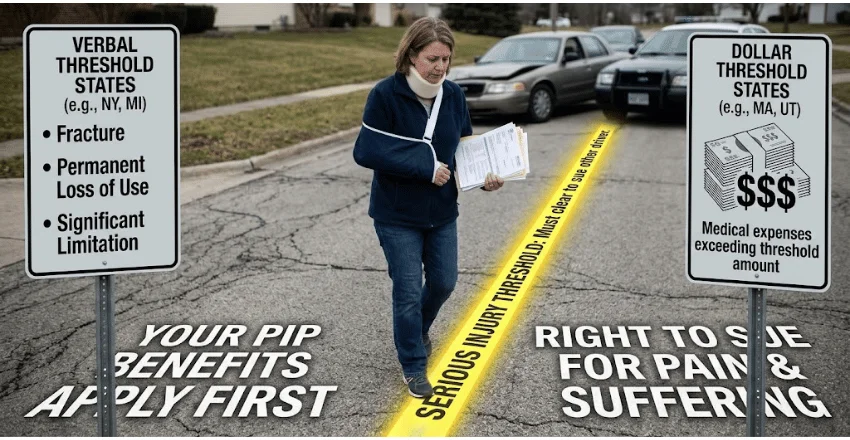
In a dozen no-fault states, your own personal injury protection pays the medical bills first. You cannot sue the other driver for these damages unless you clear a threshold. Five states use a verbal threshold, described in words: Florida, Michigan, New Jersey, New York and Pennsylvania. Seven use a dollar threshold, including Hawaii, Kansas, Massachusetts, Minnesota, and Utah.
New York’s version gets litigated most. Its insurance law counts an injury as serious if it caused any of these.
- Death, dismemberment, a fracture, or the loss of a fetus.
- Significant disfigurement, or permanent loss of use of an organ.
- A permanent consequential limitation, or a significant limitation of use.
- An injury keeping you from substantially all your usual activities for 90 of the 180 days after the crash.
Michigan asks for death, permanent serious disfigurement, or serious impairment of a body function. Florida still runs personal injury protection in 2026, with its 14-day rule for care. New Jersey and Pennsylvania let you pick your threshold at purchase, and most drivers never notice.
Do you pay taxes on it?
Usually not, with three exceptions. According to IRS Publication 4345, revised in September 2023, money received for personal physical injuries or physical sickness is not taxable. That holds provided you took no itemized deduction for the related medical expenses in an earlier year. The carve-outs are narrow.
- Emotional distress not originating in a physical injury counts as income.
- Interest on any settlement is taxable interest income.
- Punitive damages are taxable as other income, even inside a physical injury settlement.
A release splits the money between categories, and that split deserves a slow read.
Why the first offer is low

The first number is not an appraisal. It is an opening bid, and the pain and suffering line is where the insurer has room to move.
An adjuster opens with limited authority, well under the reserve on your file. Claims software then grades that file from coded entries, so anything undocumented does not exist to the model. Then there is the photo. A stiff coupe like the 2017 Infiniti Q60 survives a 15 mph hit looking untouched, and low visible property damage gets flagged.
The last reason is simplest. An adjuster is measuring your patience, betting that a check now beats a better check later. A written counteroffer with dated records moves the figure more than an angry phone call.
What to do next
Before you answer that offer, start the journal today and list the activities you have given up, with dates. Then have a licensed attorney in your state read the offer, since signing a release closes the claim. Most work these cases on contingency, so the first conversation costs nothing.
Everything here is general information about how these claims get priced, not legal advice. Injury law is state law, so the rules that count are the ones where you were hurt.
Frequently asked questions
There is no usable average. Published figures blend a $6,000 whiplash claim with a $2 million spinal cord case, so the mean describes nobody. Injury type, treatment length, and policy limits drive it.
Usually yes, at a reduced amount. Most states cut your recovery by your share of fault, and some bar it once you pass 50%. A few follow contributory negligence, where slight fault ends it.
Every state sets its own deadline, commonly two or three years from the crash, and much shorter against a government body. Miss it, and the claim ends, however strong it was.