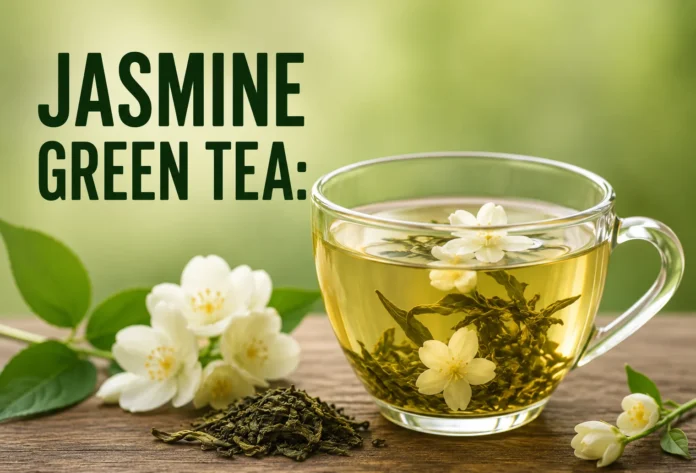
Jasmine green tea is leaf tea that has taken on the smell of fresh jasmine blossom, not a syrup or a flavoring sprayed on at a factory. Made well, it smells like a garden at dusk. Made cheaply, it tastes like soap. This page covers what your money buys, how much caffeine lands in a cup, and how to brew the leaf so it never turns bitter.
The short version: producers layer green leaf with fresh jasmine flowers overnight so the leaf drinks in the aroma, then lift the spent blossom out the next morning. A standard 8-ounce cup carries roughly 20 to 45 mg of caffeine. Brew the leaf at 175°F for two minutes, and you get a floral, faintly sweet cup with no bite at the end.
Jasmine tea at a glance
| Detail | What to expect |
|---|---|
| Base leaf | Usually a Chinese green tea from Fujian, Guangxi or Hubei |
| Where the aroma comes from | Fresh blossom laid with the leaf overnight, then sifted out |
| Caffeine per 8-ounce cup | About 20 to 45 mg |
| Water temperature | 175 to 185°F for loose leaf, 185 to 190°F for rolled pearls |
| Steep time | 2 minutes in a mug, 45 to 60 seconds for pearls in a small pot |
| Taste | Floral and sweet on top, grassy or lightly nutty underneath |
| US retail price | About $0.25 a bag, up to $7.10 an ounce for hand-rolled pearls |
| Re-steeps | 2 to 3 in a mug, 5 or more in a small pot |
TL;DR
- Real scenting means flowers and leaves spend nights together. Sprayed flavoring is the cheap shortcut, and the ingredient list gives it away.
- A cup sits well under coffee on caffeine, so an afternoon mug is fine for most people.
- Heat is what makes it bitter, not the jasmine. Keep the water off the boil.
- You can drink well for $5 a box, and the jump to loose leaf costs about $3.50 an ounce.
What jasmine green tea is, and how makers scent it
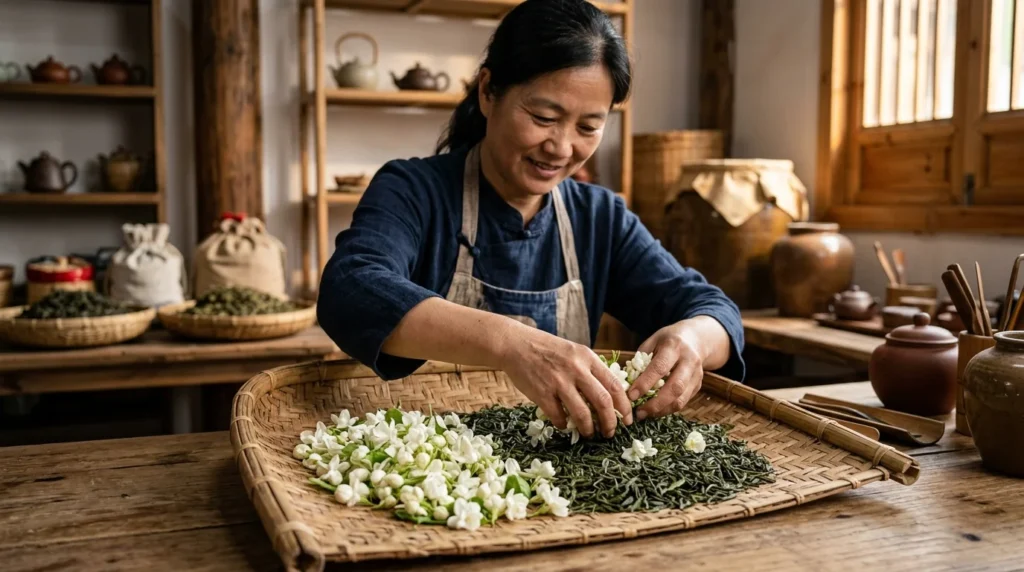
Start with the plant. All true tea comes from Camellia sinensis, and the green version skips oxidation, so the leaf keeps its fresh, grassy character. Jasmine is a separate plant entirely. Those two only meet after harvest.
Here is the part the product pages skip. Pickers take the tea leaves in spring and store them. They pick jasmine buds in the summer heat, in the afternoon, while the buds are still closed. That evening the buds and the leaves go into layers together in a cool room. Flowers open in the dark and pour their perfume into the dry leaf, which drinks it in. Next morning workers sift the spent blossom out and gently dry the leaf again.
Then they do it again. And again.
A cheap supermarket blend might see one night of flowers. Premium lots repeat the cycle up to six or seven times over several weeks, with fresh blossom each round. That repetition is most of what you pay for.
What it tastes like, and why the base leaf matters
Aroma arrives before flavor does. Lift the cup, and you get honeysuckle and warm stone fruit; then the liquid itself is much quieter: soft, green, slightly sweet, with a clean finish. Good examples never taste perfumed. If your mouth feels coated and floral for ten minutes afterwards, you are drinking flavoring rather than scent.
Not every jasmine tea uses a green base, and the choice changes the cup, the caffeine, and the price.
How the base leaf changes the drink
| Base | Cup | Caffeine, 8 oz | Typical US price |
|---|---|---|---|
| Green | Grassy and light, the standard pairing | 20 to 45 mg | $0.25 a bag to $5 an ounce |
| White (silver needle) | Softer, sweeter, less body | 15 to 40 mg | $6 to $12 an ounce |
| Oolong | Creamy, peachy, more weight | 30 to 50 mg | $5 to $10 an ounce |
| Black | Malty under the flowers, rare in the US | 40 to 70 mg | $3 to $8 an ounce |
Most people drink the green version because the leaf is quiet enough to let the jasmine speak. It is also the one you can buy in any grocery aisle. If you drink it in the evening to slow down, treat the ritual as one of several simple steps to reduce stress rather than a cure on its own.
How much caffeine does a cup carry?
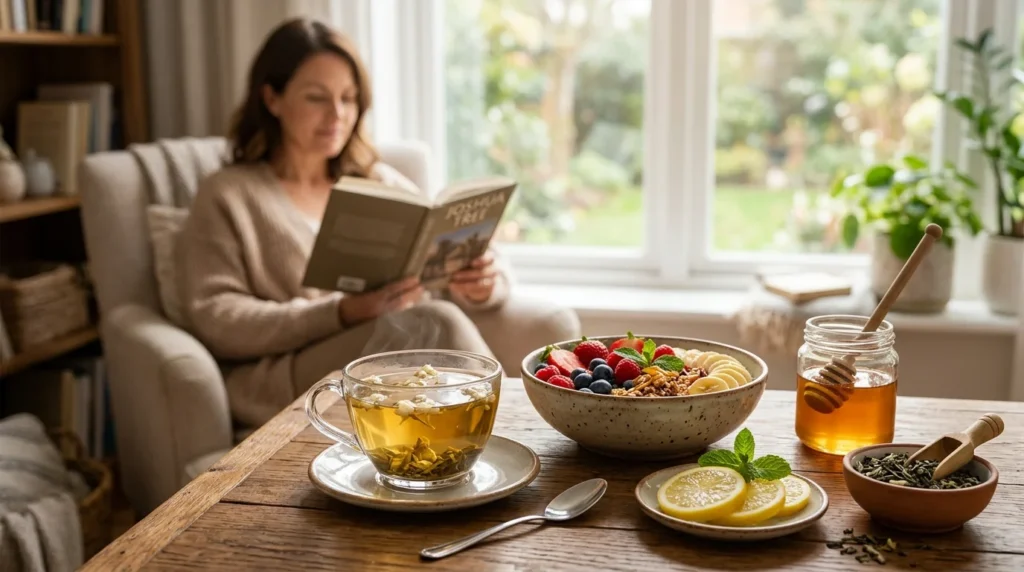
Enough to notice, not enough to worry about. The FDA caffeine guidance puts plain green tea at 37 mg in a 12 fluid ounce serving. That same agency names 400 mg a day as an amount not generally tied to negative effects in healthy adults. Scenting adds aroma, not stimulant, so a jasmine version of the same leaf lands in the same range.
In practice, an 8-ounce mug gives you roughly 20 to 45 mg. Steep longer and hotter and you pull more. Compare that against a daily total: a single 8-ounce coffee runs near 95 mg, so three mugs of this tea still sit below one coffee. Very few page one results make that comparison, and it is the figure most readers actually want.
Timing matters more than the number. Caffeine has a half-life of about five hours, so a 4pm cup still has half its punch working at 9pm. Anyone chasing better rest should read the caffeine cutoff as part of the wider steps toward a better night of sleep, not as a standalone fix.
Pregnant and breastfeeding readers are usually advised to stay under 200 mg of caffeine a day. Ask your own doctor before you set a limit.
How to brew it so it doesn’t turn bitter
Bitterness comes from heat and time, not from the flowers. Boiling water scorches green leaves and drags out tannin, which buries the aroma you paid for.
- Heat the water to 175°F. No thermometer? Boil, then let the kettle stand uncovered for four minutes.
- Use one teaspoon of loose leaf, or one bag, per 8 ounces of water.
- Steep for two minutes. Taste. Give it another 30 seconds if you want more body.
- Lift the leaf out. Leaving it in the mug is the single most common mistake.
- Re-steep the same leaf twice more, adding 30 seconds each round.
Rolled pearls behave differently. They need hotter water, 185 to 190°F, because the tight balls have to unfurl before anything happens. Give the first infusion 45 to 60 seconds, then add 15 seconds a round. Tea bags are the loosest case of all: the dust inside extracts fast, so 90 seconds is plenty.
Cold brewing skips the problem entirely, and nobody on page one mentions it. Drop four teaspoons of leaf into a quart jar of cold water, seal it, and leave it in the refrigerator overnight. Eight hours later, you strain it and get a sweet, thick, completely smooth drink with no astringency at all. Serve it plain, or with a squeeze of lemon if you like what lemon brings to a cold drink.
Is it good for you?
The honest answer is that the green leaf does the work and the jasmine makes you want to drink it. Green tea carries catechins, mainly EGCG, which act as antioxidants. It also carries L-theanine, an amino acid linked with a calm, alert state that takes some of the edge off caffeine.
Claims about fat burning and disease risk run far ahead of the evidence, and most of the studies behind them used extracts at doses no drinker reaches. If your interest is cardiovascular, our piece on whether tea can lower blood pressure walks through what the trials on green and black tea actually measured.
One practical note: swapping a sweetened drink for an unsweetened cup removes real sugar from your week. That change is worth more than any single compound in the leaf.
What it costs in the US, and what the label names mean
Nobody ranking for this term publishes current retail prices, so here are figures checked in August 2026.
What jasmine tea costs in the US
| What you buy | Price | Works out at | Suits |
|---|---|---|---|
| Supermarket tea bags, 20 count | $4.99 | $0.25 a bag | Daily mug, zero fuss |
| Mid-range loose leaf, 4 oz tin | $14.00 | $3.50 an ounce | The obvious upgrade |
| Organic loose leaf, 1/4 lb | $20.00 | $5.00 an ounce | Traceable sourcing |
| Hand-rolled pearls, 2 oz | $14.20 | $7.10 an ounce | Gifts, slow weekend brewing |
Labels carry grade names that look impenetrable until you know four of them:
- Yin Hao, or silver tip, means the leaf includes downy buds. Softer and sweeter.
- Mao Feng describes a slender bud-and-leaf pluck. Clean and light in the cup.
- Dragon pearls, sometimes called Long Zhu, are leaves hand-rolled into balls that open as they steep.
- Bi Luo Chun refers to a tightly curled leaf shape with a fuller, nuttier body.
None of these are legally protected terms. They describe leaf shape and picking standard, which correlate with price but do not guarantee good scenting.
How to spot real scenting, and how to store it
Four checks separate traditionally scented tea from leaves sprayed with jasmine flavoring or oil. Read the ingredients. “Green tea, jasmine flowers” is the good sign. “Natural flavor” or “jasmine oil” means the perfume went on at the end.
- Smell the dry leaf. Real scenting reads sweet and slightly creamy. Sprayed product smells sharp, like a candle.
- Steep it three times. Scented leaf still carries jasmine on the third go. Flavoring washes off after the first.
- Ignore petal count. Loose petals in the pouch are decoration, since properly scented leaf usually has the blossom sifted out.
Storage gets ignored on every ranking page, and it matters here more than with other teas. Aroma is volatile, so it fades first and fastest. Keep the pouch airtight, away from light, heat, and anything strongly scented in your cupboard. Once opened, finish it within six months. After that, you still have decent green tea, but the flowers have largely gone. Buy small and often. A 2-ounce bag you finish in a month beats a pound you drink for a year.
Where to start
Buy two things this week. Pick up a $5 box of bags for weekday mornings, then order 2 ounces of dragon pearls for the weekend, and brew them side by side in the same water. The gap between them will tell you more about scenting than any description can, and you will know within one sitting which tier is worth your money.
Frequently asked questions
Not quite. Jasmine green tea starts as ordinary green tea, then goes through scenting. The base leaf, caffeine, and catechins are the same; the aroma is the addition.
Yes, for most healthy adults. Three or four cups a day sits comfortably inside the FDA’s 400 mg caffeine figure. Cut back if you notice jitters or disturbed sleep.
Only indirectly. The L-theanine and the warm ritual are calming, but the caffeine works against you close to bedtime. Choose a herbal infusion after about 4pm.
Not on its own. Replacing sweetened drinks with an unsweetened cup cuts calories, which is the real mechanism. Green tea extract studies do not translate to a mug of tea.
Water too hot, leaf left in too long, or both. Drop to 175°F and pull the leaf after two minutes.