A restaurant group files for Chapter 11 on a Monday morning. Its lease says the landlord may cancel the second the tenant files for bankruptcy. So the landlord calls his attorney, expecting good news. He gets the opposite, because that sentence in the lease is probably worthless.
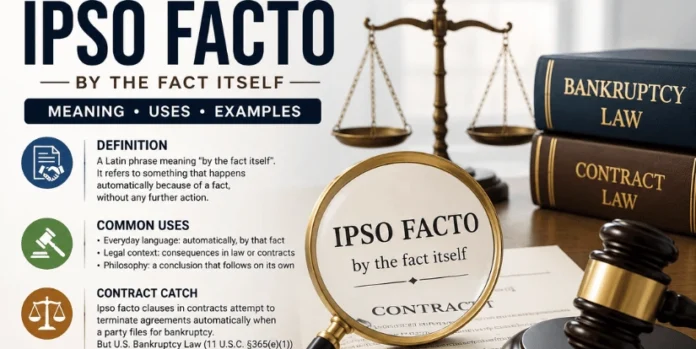
The Latin phrase means “by the fact itself.” Something counts as true or takes effect purely because of a fact that already exists. No hearing, no ruling, no extra paperwork. Say it IP-so FAK-toh. In contracts, “ipso facto” names a clause that fires on its own the moment a company goes broke.
Here is the whole term on one card.
| Question | Answer |
| Literal Latin | by the fact itself (ipso, “itself”; facto, “fact” or “deed”) |
| Pronunciation | IP-so FAK-toh, four syllables, stress on IP and FAK |
| Part of speech | adverb, sometimes an adjective in front of a noun |
| In English since | 1548, per Merriam-Webster |
| Plain swaps | automatically, by that very fact, in itself, so |
| Where it matters most | bankruptcy contracts, court opinions, canon law, logic |
| Often mixed up with | de facto, de jure, ipso jure, per se |
Key Takeaways
- The two words mean “by the fact itself,” so a result follows with no extra step.
- Everyday English uses it to mean “automatically” or “by that very fact.”
- Contract drafters use it for a clause that kills a deal on insolvency or a bankruptcy filing.
- Bankruptcy Code sections 365(e)(1) and 541(c)(1) usually turn that clause into a dead letter.
- Swaps, repos, securities contracts, and personal-service deals sit outside the protection.
- It is not a synonym for “de facto,” and the two get swapped constantly.
How to say it and where it came from
Four syllables, no trap: IP-so FAK-toh. Stress lands on the first and third syllables. Some speakers soften the final vowel to “tuh.” Nobody will correct you. Grammar rewards a second look here. Both words sit in the Latin ablative case, the case of “by” or “with” phrases. Ipso is a form of ipse, meaning “itself.” A fact comes from a factum, a fact or a thing done. Ipso facto: Stack them, and you get “by the fact itself,” which is exactly how the expression behaves in English today. Merriam-Webster traces its use in English writing back to 1548, so this is not a modern coinage.
The Same Two Words, Five Different Jobs
Register changes to what the phrase is doing. Five examples sit side by side in the table below, running from everyday speech to philosophical argument. Watch the hyphen in rows three to five. Writers hyphenate it when it sits in front of a noun as a modifier and leave it open when it works as an adverb.
| Where you hear it | Example sentence | What it means there |
| Everyday speech | Anyone who signs the lease is ipso facto responsible for the rent. | automatically, no further step |
| Court opinions | He drove the getaway car and was ipso facto an accessory. | The fact settles the legal question. |
| Contracts | The loan agreement has an ipso facto clause that ends it the day the borrower files. | A self-executing trigger |
| Philosophy and logic | Rarity is not an ipso-facto guarantee of value. | The conclusion does not follow on its own. |
| Canon law | Certain offenses carry ipso-facto excommunication. | The penalty lands without a trial. |
Three of those five are plain English. Those other two carry real money, and that is where most explainers stop.
Ipso Facto Clauses: The Contract Term That Stops Working
Open a commercial lease, a franchise deal, or a supply contract. Sooner or later you hit a line that reads roughly like this: the deal ends immediately upon the insolvency or bankruptcy of either party. That trigger isn’t related to a missed payment or poor work. It is the money trouble itself. Even the lease paperwork on a family crossover like the 2020 Infiniti QX50 hides one near the default section, where almost nobody reads.
The clause only applies to an executory contract, which is shorthand for a deal where both sides still owe each other something. A paid invoice is finished business. A twelve-month retainer with an enterprise SEO agency is executory because the agency still owes work and the client still owes money. Leases behave the same way.
Congress disarmed most of these clauses when it wrote the modern Bankruptcy Code in 1978. The text of 11 U.S. Code § 365, published by Cornell Law School’s Legal Information Institute, shows the rule in subsection (e)(1). A contract or lease cannot be ended after a case starts if the only reason is a clause keyed to the debtor’s insolvency or the filing itself. That text still reads the same way in 2026.
So the landlord in our opening scene has a problem. His clause is not illegal. It simply loses its power at the courthouse door, and he now has to prove an ordinary default instead.
When the clause still bites
Protection here is broad, not total. Five situations where a termination-on-bankruptcy line can still do real damage:
- Nobody files. Outside bankruptcy court, state contract law governs, and the clause is as enforceable as any other term. A company that is merely insolvent gets no shield.
- Personal-service contracts. Sections 365(e)(2) and 365(c)(1) keep the clause alive when nonbankruptcy law lets the other side refuse performance from anyone but the original party. Think of a famous opera singer who cannot hand her booking to a trustee.
- Financing commitments. A promise to make a loan, extend other debt financing, or issue a security for the debtor is carved out by name. Your lender does not have to keep funding you.
- The financial safe harbors. Code sections 555, 556, 559, 560, and 561 let counterparties close out securities contracts, commodity contracts, forward contracts, repurchase agreements, swaps, and master netting agreements right away. Wall Street lobbied hard for these, and they held up through the 2008 crisis.
- Consumer leases in Chapter 7. An individual who wants to keep a leased car normally has to assume the lease under section 365(p), and the leasing company can say no.
Notice the pattern. Carve-outs cover deals where forcing a stranger to keep performing would be unfair or would spread risk through the financial system.
Why the Rule Exists at All
A business in Chapter 11 is trying to reorganize. Picture a small chain paying $9,500 a month on each of three store leases. Strip away those leases, its software licenses, and its supply agreements on day one, and nothing is left to reorganize. Breathing room is the whole point of the rule.
Section 541(c)(1) works the same street from the other side. It sweeps the debtor’s property into the bankruptcy estate even when an agreement says that property is forfeited or transferred on insolvency. An estate here means the whole pile of holdings, the way a figure like Ann Getty’s net worth bundles investments, real estate, and art into one number. The Code wants that pile whole so that the court can pay creditors in a fair order rather than a race.
De Facto, De Jure, Per se: sorting the Latin cousins
These get swapped in casual writing, and the swap changes the meaning. Our term is about a fact producing a result. Each of the others does different work.
| Term | Literal meaning | What it signals |
| de facto | in fact | true in practice, whatever the paperwork says |
| de jure | by law | true on paper, whatever happens in practice |
| ipso jure | by the law itself | The statute produces the result; no court order is needed. |
| per se | by itself | in and of itself, without anything more |
| prima facie | at first sight | enough evidence to win unless the other side answers it |
| ergo | So, for that reason | marks a conclusion in an argument |
The closest neighbor is ipso jure. One says the fact does the work; the other says the statute does. Lawyers slide between them, and outside a courtroom the difference rarely matters.
Should you use it in your own writing?

Usually not. Plain English is clearer, and “automatically” or “by that very fact” says the same thing without making a reader stop. Two cases earn the Latin:
- You are naming the contract clause, where the term is the accepted label and swapping it out creates confusion.
- You are quoting a court, a canon-law rule, or a philosopher who used it.
Everywhere else, write the plain word. If you do use it, keep it unhyphenated as an adverb, italicize it only when your style guide asks, and never stack it with “therefore” in the same sentence. That doubling is a common tell in first drafts.
Your Next Step
Reading a contract this week? Search the document for “insolvency” and “bankruptcy” and see what the clause claims to do. Then ask two questions: does either side still owe performance, and is this one of the carved-out deal types? Those two answers tell you whether the clause has teeth.
Ipso facto: one honest caveat. This is general information about how a federal statute works, not legal advice about your contract. Statutes get amended, courts split on the edge cases, and your facts matter more than any article. If real money rides on the answer, put a bankruptcy attorney in front of the document before you act on it.
Frequently Asked Questions
It means the result follows from the fact alone. Nothing else has to happen: no ruling, no vote, no signature. If a rule says members who miss three meetings lose their seat, they lose it the moment the third absence happens.
“De facto” describes a state of affairs that is real in practice, like a de facto boss who has no title. Our phrase describes a consequence that follows automatically from a fact. One labels reality; the other links cause to effect.
Yes, and most drafters still do. It is not banned, and it keeps working in state court against a party that never files. Just do not treat it as a real remedy once a bankruptcy petition lands.
Section 365 applies across Chapter 7, 11, 12, and 13 cases. The practical results differ, because a Chapter 7 trustee often abandons contracts that a Chapter 11 debtor would fight to keep.
In everyday prose, mostly. In bankruptcy practice, it is alive and used weekly, because the statute and decades of case law are built around the label.