
Choosing keywords isn’t about finding the phrases with the highest search volume. You need terms that match your audience, content, and competitive ability. This guide explains how to choose best keywords for SEO when targeting searchers in the United States.
The best SEO keywords combine strong relevance, clear search intent, realistic competition, and useful traffic potential. Start with topics your audience already searches for. Then compare search demand, ranking difficulty, SERP results, and business value before assigning one primary keyword to each page.
Keyword Selection at a Glance
| Factor | What to Check | Why It Matters |
|---|---|---|
| Relevance | Does the query match your topic or offer? | Irrelevant traffic rarely produces useful results |
| Search intent | What does the searcher expect to find? | Your content format must match expectations |
| U.S. search volume | How often Americans search the phrase | It estimates potential demand |
| Competition | How strong are ranking pages? | It shows whether ranking is realistic |
| Business value | Can the visitor support your goals? | Traffic alone does not create value |
| Trend | Is interest growing or shrinking? | Rising topics can create new opportunities |
| SERP fit | Can your page compete with current results? | Google already reveals the preferred format |
Key Takeaways
- Target relevance before chasing large search volumes.
- Set keyword tools to the United States before comparing demand.
- Match informational, commercial, transactional, or navigational intent.
- Compare current ranking pages instead of trusting difficulty scores alone.
- Use long-tail phrases when they provide clearer intent and realistic competition.
- Assign one main keyword to each page to reduce keyword cannibalization.
- Review performance in Google Search Console after publishing.
Why Choosing the Right SEO Keywords Matters
A keyword connects a searcher’s question with the page you want Google to display. Poor choices can attract visitors who never needed your content. Strong choices bring people whose needs closely match your page.
Search volume cannot measure that match by itself. A smaller phrase may attract fewer people but deliver a more useful audience. That difference matters for publishers, service businesses, affiliate sites, and online stores.
For example, “SEO” has broad meaning and extreme competition. “SEO keyword research for small business” describes a narrower problem. The second phrase often gives you clearer direction for the page.
How to Choose Best Keywords for SEO in 7 Steps
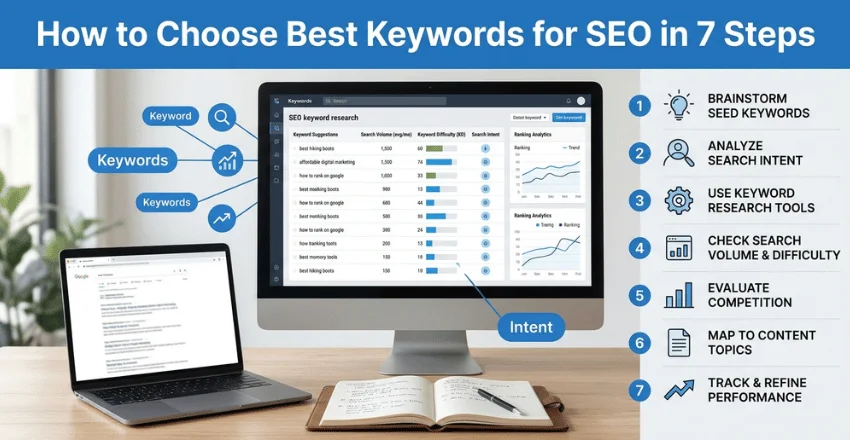
The process works best when you systematically narrow a large list of ideas. Each step removes weak opportunities before you invest in content. Follow these seven steps for a practical keyword selection process.
1. Start With Topics That Matter to Your Audience
Begin with several broad topics connected to your site’s purpose. Think about problems readers need solved instead of words you want to rank for. This approach keeps keyword research tied to real demand.
A digital marketing site might begin with topics such as SEO, advertising, content marketing, and website growth. Each broad topic can produce dozens of more specific searches. Those specific searches become your candidate keyword list.
Use customer questions, comments, forums, competitor pages, and existing site data for ideas. Google Search Console can show queries already generating impressions for your website. Google explains that its Performance reports include queries, clicks, impressions, CTR, and position data.
2. Generate Keyword Ideas From Seed Terms
Enter your broad topics into a keyword research tool. Add your website when the tool supports domain-based suggestions. Save relevant phrases before filtering them aggressively.
Google Keyword Planner can generate ideas from words, websites, or both. It also provides estimated search demand for keyword ideas. Make sure your targeting settings focus on the United States for this project.
Paid tools can add difficulty estimates, competitor data, keyword clusters, and SERP information. Semrush also recommends reviewing competitor keywords and terms your site already ranks for. These sources help expand your list beyond obvious phrases.
3. Check Search Intent Before Search Volume
Search intent describes what someone wants after entering a query. A keyword can have strong volume and still be wrong for your planned page. Always inspect the current search results before choosing it.
Most searches fall into four useful intent groups:
- Informational: The person wants an answer or explanation.
- Commercial: The person is comparing products, services, or options.
- Transactional: The person wants to buy, book, download, or take action.
- Navigational: The person wants a particular brand, website, or page.
Google’s results reveal which format currently satisfies the query. A results page filled with tutorials suggests instructional intent. A results page filled with product pages suggests buying intent.
Ahrefs also recommends checking actual search results when determining keyword intent. Different intents usually require different page formats. Matching the correct format gives your content a stronger chance of satisfying visitors.
4. Evaluate U.S. Search Volume Without Chasing It
Search volume estimates how frequently people search for a phrase. It can help you compare demand between similar keyword opportunities. It should never become your only selection rule.
Set your keyword research location to the United States. Global volume can distort decisions when your audience is primarily American. A keyword may be popular internationally while attracting limited U.S. demand.
You should also check whether interest changes throughout the year. Seasonal phrases can show impressive monthly averages while driving traffic for only a few weeks. Google Trends can help you identify changing, location-specific search interest.
5. Judge Ranking Difficulty From the Actual SERP
Keyword difficulty scores are useful comparison tools, but they are estimates. The current results page provides more practical evidence about your competitors. Review the sites, page types, content depth, and relevance of ranking results.
Ask these questions before targeting a phrase:
- Are the top results dominated by major authority websites?
- Are smaller or newer sites ranking on page one?
- Do ranking pages answer the search intent well?
- Can you offer clearer information or stronger examples?
- Does your site already have authority around this topic?
A lower-volume phrase with realistic competition can outperform a huge keyword you cannot reach. The goal is not to choose the easiest phrase available. You need the strongest intersection of demand, relevance, and ranking opportunity.
Large websites face different SEO challenges from smaller publishers. ENF Blogs covers those differences in its enterprise SEO agency guide. That article can help readers understand how scale changes keyword and technical priorities.
6. Prioritize Long-Tail Keywords With Clear Intent
Long-tail keywords are longer and more specific search phrases. Their individual search volumes may be lower than broad head terms. Their specificity can make the searcher’s goal easier to understand.
Compare “keyword research” with “how to find low competition keywords for a new blog.” The second query tells you much more about the user’s situation. You can build a page that answers that problem precisely.
Long-tail targeting is especially useful for developing websites. It lets you build topical authority around narrower questions before pursuing highly competitive head terms. Over time, those supporting pages can strengthen larger topic clusters.
Technical quality also affects whether good content performs effectively. ENF Blogs discusses SEO and site performance within its web design and optimization article. Keyword targeting works better when the supporting website provides a strong user experience.
7. Score Keywords by Business Value and Ranking Potential
Your final decision needs more than volume and difficulty. Give each candidate a simple score based on relevance, intent, opportunity, and business value. This prevents attractive metrics from overpowering strategic fit.
A simple five-point model works well:
| Criterion | Score |
|---|---|
| Strong audience relevance | 1 |
| Clear intent match | 1 |
| Useful U.S. search demand | 1 |
| Realistic ranking opportunity | 1 |
| Supports a business or publishing goal | 1 |
Prioritize keywords scoring four or five points. Reconsider phrases scoring two or fewer points. A scoring system also makes keyword choices easier to explain across a team.
Traffic value may also depend on other marketing channels. ENF Blogs explains audience targeting within its streaming advertising guide. That broader context can help marketers compare organic search with paid audience acquisition.
Map One Primary Keyword to One Page
After choosing your target terms, create a keyword map. Assign one primary query to the page that best satisfies its intent. Group closely related secondary phrases under that same page.
Do not publish separate thin articles for every slight wording variation. Search engines can often understand closely related phrases as part of one topic. Separate pages make more sense when the intent or expected answer changes substantially.
This process also reduces keyword cannibalization. Cannibalization happens when several pages compete for nearly the same query. Clear keyword mapping gives each important page a distinct purpose.
A Practical Keyword Example
Suppose a U.S. marketing blog wants traffic about local SEO. The seed keyword “local SEO” may be too broad for a newer website. More specific phrases can provide clearer opportunities.
Consider these three examples:
| Keyword Type | Example | Likely Intent | Priority |
|---|---|---|---|
| Broad | local SEO | Mixed | Medium |
| Specific | local SEO tips for small business | Informational | High |
| Commercial | best local SEO tools for small business | Commercial | High |
The broad phrase can support a future pillar page. The informational phrase suits a practical tutorial. The commercial phrase needs comparisons, benefits, limitations, and a clear recommendation.
This example shows why you choose keywords before writing. Query wording changes the expected content format. Choosing the phrase first prevents you from building the wrong page.
Common Keyword Research Mistakes to Avoid
Many keyword strategies fail because they prioritize numbers over readers. High search demand can look attractive inside a spreadsheet. It becomes useless when the resulting audience does not match your content.
Avoid these common mistakes:
- Choosing keywords only because they have high volume.
- Ignoring search intent and current ranking formats.
- Using worldwide volume for a U.S.-focused website.
- Publishing many pages for tiny keyword variations.
- Targeting competitive head terms without supporting topical authority.
- Ignoring keywords already earning impressions.
- Treating paid-search competition as organic ranking difficulty.
- Never reviewing performance after publishing.
Google Keyword Planner primarily supports advertising research. Its competition information should not be treated as a direct organic-ranking score. Use the live organic results to evaluate SEO competition more carefully.
How Often Should You Review Your Keywords?
Review important keyword targets once you have enough search data. Look for growing impressions, improving positions, and queries you did not originally target. Those unexpected queries can reveal opportunities to expand your content.
Search behavior also changes over time. New products, terminology, events, and technologies create new searches. Older phrases may lose demand or shift intent.
For active content sites, a quarterly review provides a practical starting point. Important commercial pages may deserve more frequent attention. Use actual Search Console data rather than replacing targets based on short-term ranking fluctuations.
FAQ About Choosing SEO Keywords
What makes a good SEO keyword?
A good keyword matches your audience, page topic, and intended content format. It should have enough demand to justify creating or improving the page. Your website should also have a reasonable chance to compete.
Should I choose high-volume or low-competition keywords?
Neither metric should decide the target alone. A useful keyword combines relevance, intent, demand, business value, and realistic competition. Smaller sites often benefit from specific searches where existing results leave room for improvement.
How many keywords should one page target?
Choose one primary keyword and several closely related secondary phrases. They should share the same basic search intent. Create another page when the expected answer or content format changes.
Are long-tail keywords better for new websites?
Long-tail phrases can be useful because they usually describe narrower needs. Clearer intent makes it easier to create focused content. Competition can also be more manageable than broad head terms.
How do I choose the best keywords for SEO for a U.S. audience?
Set your research tools to the United States first. Compare U.S. demand, search intent, ranking competition, trends, and business relevance. Choose terms where your page can provide a stronger answer than current results.
Final Keyword Selection Checklist
Before approving a target keyword, check the complete opportunity. Confirm that the query fits your audience and supports a useful page. Then verify that the existing results leave a realistic opening.
Use this checklist:
- The keyword is directly relevant to your audience.
- The intent matches the page you plan to create.
- U.S. search demand supports the effort.
- The current SERP is realistic for your website.
- The keyword has clear reader or business value.
- Closely related variants belong on the same page.
- No existing page already targets the same intent.
- You can provide something clearer or more useful than current results.
Learning how to choose best keywords for SEO becomes easier when you stop chasing volume alone. Relevance and intent should lead every decision. Use search demand and competition to decide which relevant opportunities deserve priority.
Your next step is to build a shortlist of ten candidate keywords. Score each using relevance, intent, demand, difficulty, and value. Then choose the strongest keyword and map it to one specific page.