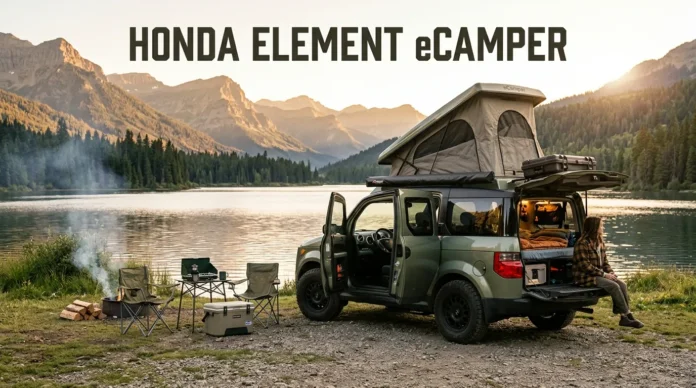
The Honda Element ECamper turns Honda’s boxy compact SUV into a small pop-top camper with an upstairs sleeping area. It remains attractive for travelers who want everyday transportation and weekend camping in one vehicle. The biggest change for 2026 is that ordering a new conversion now works differently.
Ursa Minor ended regular ECamper production on December 31, 2025. The company now accepts conversions only as custom projects at its Oregon facility. Buyers should therefore compare a custom conversion with the growing market for used ECampers.
Direct answer: The ECamper is an Ursa Minor pop-top conversion built specifically for 2003–2011 Honda Elements. It adds a loft bed, standing space, lighting, ventilation, and inside access. New conversions remain possible in 2026, but they are custom quoted and typically require advance scheduling.
ECamper Quick Facts
| Feature | Current Details |
|---|---|
| Base vehicle | 2003–2011 Honda Element |
| Conversion company | Ursa Minor Vehicles |
| Current production status | Custom conversions only |
| Regular production ended | December 31, 2025 |
| Current conversion price | Individually quoted |
| Typical 2026 lead time | About 3–6 months |
| Installation location | Portland-area Oregon facility |
| Loft mattress | About 7 feet by 4 feet |
| Standard sleeping capacity upstairs | Two adults |
| DIY kit available | No |
| Used examples | Commonly listed through private marketplaces and enthusiast classifieds |
Key Takeaways
- Regular ECamper production ended after 2025.
- Custom conversions can still be requested from Ursa Minor.
- Current pricing depends on vehicle condition and selected options.
- All model years from 2003 through 2011 can potentially qualify.
- Used examples can cost far less than building one from scratch.
- Vehicle condition matters as much as camper condition.
- The ECamper works best for travelers comfortable with compact camping.
What Is the Honda Element ECamper?
The ECamper is a permanent pop-top conversion developed by Ursa Minor Vehicles. Ursa Minor built its first ECamper in 2007. The design uses the Element’s tall, square body as the foundation for a compact camping vehicle.
The raised roof includes a sleeping loft rather than just a rooftop tent. Campers can access the loft from inside the vehicle on compatible configurations. Screened fabric walls provide airflow and views when the roof is raised.
The concept preserves most of the Element’s everyday usefulness. Owners still get a compact footprint compared with a conventional camper van. That balance explains why the conversion continues attracting enthusiasts years after Honda stopped producing the Element.
Readers researching other distinctive compact vehicles can also see ENF Blogs’ feature on the 2010 Mini Cooper. Both vehicles show how unusual packaging can create more utility than exterior dimensions suggest. The Element simply takes that idea much further for camping.
What Changed for the ECamper in 2026?
The most important 2026 change concerns availability, not the camper itself. Ursa Minor officially ended serial ECamper production on December 31, 2025. Beginning January 1, 2026, conversions moved to a custom-project model.
That change means there is no universal current base price. Ursa Minor says pricing depends on the Element’s configuration, condition, selected accessories, and component costs. Scheduling also depends on shop capacity and parts availability.
The company currently estimates a typical lead time between three and six months. All conversions are completed at its Portland-area Oregon location. Ursa Minor does not ship an ECamper kit for owners or independent shops to install.
Older articles often quote fixed starting prices around $7,500 or similar amounts. Those figures described earlier production periods and should not be treated as 2026 pricing. Anyone considering a new build should request a current quote directly from Ursa Minor.
ECamper Features and Sleeping Setup
The standard conversion adds a full-length loft with a two-inch foam mattress. Ursa Minor also includes LED lighting in the loft area. A rear hatch release improves access when campers are using the vehicle as living space.
The sleeping platform measures roughly seven feet long and four feet wide. That provides room for two people upstairs. Owners can configure the lower cabin separately for storage, seating, or another sleeping arrangement.
Gas-assisted hardware makes the roof easier to raise and close. Screened openings in the fabric provide ventilation when camping in warm conditions. The low-profile roof remains attached permanently while the vehicle is driven.
The design is closer to minimalist car camping than a conventional recreational vehicle. There is no built-in bathroom, large kitchen, or residential living area. Buyers should view it as an upgraded micro-camper, not a miniature motorhome.
For more automotive ownership and maintenance content, readers can browse the ENF Blogs Automobile section. Vehicle condition matters most when adding expensive equipment to an older platform. A healthy base vehicle usually makes the camping investment easier to justify.
Which Honda Element Years Can Be Converted?
Ursa Minor says it can work with Honda Elements from the full 2003–2011 production run. Access to the sleeping loft differs depending on year and drivetrain configuration. Buyers should understand that difference before shopping for a donor vehicle.
Many 2003–2008 AWD Elements have the factory sunroof opening used for interior loft access. Other configurations require an access opening created during the conversion. Ursa Minor expanded its design to accommodate non-sunroof Elements during the product’s development.
Optional rear spoilers can also affect conversion work. Ursa Minor states that conflicting Honda spoilers must be removed. Vehicle condition may create additional limitations because every remaining Element is now at least fifteen years old.
Age alone does not automatically disqualify an Element. Ursa Minor reports converting vehicles with extremely high mileage in the past. Structural condition, corrosion, mechanical health, and repair history deserve closer attention than mileage alone.
How Much Does a Honda Element ECamper Cost in 2026?
There is no published fixed price for a new 2026 conversion. Ursa Minor now quotes each project based on the donor vehicle and desired equipment. Buyers should budget for both the conversion and any mechanical work their older Element needs.
The used market provides a more visible price reference. A 2010 ECamper with about 126,600 miles appeared in California for roughly $17,500 in September 2026. Another 2010 example with about 180,600 miles was listed for about $19,000 earlier in 2026.
Condition can dramatically change the asking price. A 2008 AWD example with rust and repair needs appeared at $8,500. Another 2008 AWD ECamper with 154,628 miles sold after being advertised for $17,999 in September 2026.
| 2026 Used Example | Mileage | Asking Price | Important Context |
|---|---|---|---|
| 2008 LX AWD | 140,000 | $8,500 | Needed rust and brake repairs |
| 2010 EX FWD | 126,600 | $17,500 | Clean-title California vehicle |
| 2008 EX AWD | 154,628 | $17,999 | Sold September 2026 |
| 2010 LX 2WD | 180,600 | $19,000 | Original owner with service records |
These examples are approximate snapshots of listings, and asking prices change quickly, so verify current figures before relying on them. They also demonstrate why advertised price alone tells little about value. Rust, service records, drivetrain, camper condition, title history, and accessories can change the equation. A cheaper vehicle requiring structural repairs may become the more expensive choice.
What Should You Check Before Buying a Used ECamper?
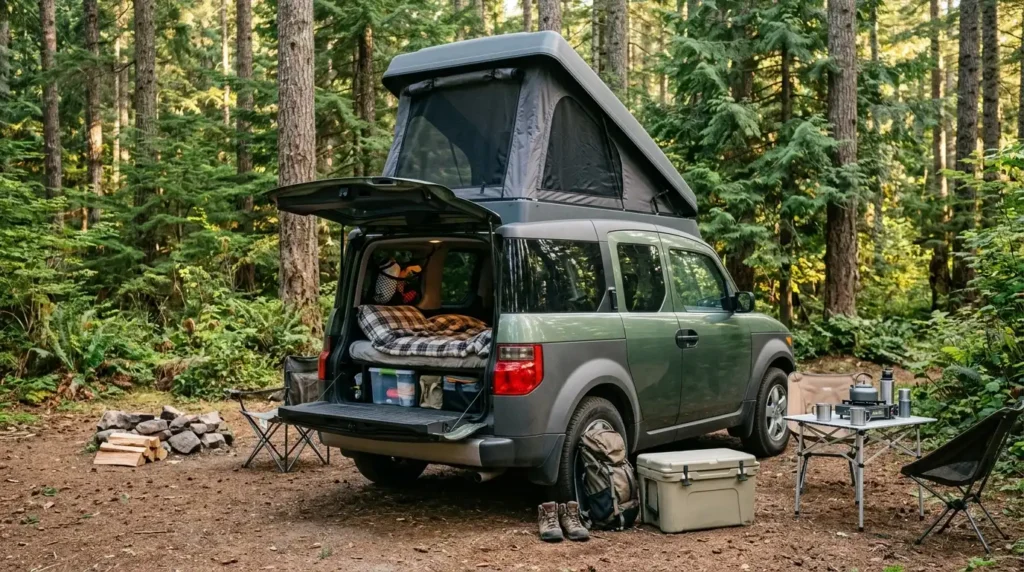
Start with the Honda itself before focusing on the pop-top. Check service records, corrosion, suspension condition, fluids, tires, brakes, and warning lights. An independent mechanic’s pre-purchase inspection can reveal costs hidden by an attractive camper setup.
Inspect the ECamper fabric for tears, mildew, water intrusion, and damaged screens. Raise and lower the roof several times while watching the hinges, latches, seals, and lifting hardware. Confirm that loft lighting and the rear hatch release operate correctly.
Inspect the roof attachment areas closely for any signs of previous repairs. Investigate water damage before purchase because leaks can affect more than fabric. Ask when seals, mattress materials, and camper hardware were last serviced.
Glass and body condition also deserve attention on an aging travel vehicle. ENF Blogs’ guide to auto glass repair and vehicle safety explains why damaged automotive glass should not be ignored. Camping use can expose older vehicles to more highway miles and changing weather.
Pros and Cons of the ECamper
The strongest advantage is its compact size. You can camp in a vehicle that remains easier to park and drive than most vans or RVs. The permanent loft also removes much of the nightly setup associated with separate ground tents.
Another advantage is interior flexibility. The upstairs bed leaves the lower cabin available for gear, seating, or another sleeping setup. Inside access can also make nighttime entry easier during poor weather.
The largest drawback is the age of every available Honda Element. Honda ended production after the 2011 model year. Buyers are therefore combining a specialized camper with an aging vehicle that may need increasing maintenance.
Space is another limitation. Couples who enjoy simple camping may find the layout ideal. Travelers expecting a bathroom, indoor kitchen, large water system, or substantial storage should consider a larger camper.
Is an ECamper Better Than a Rooftop Tent?
An ECamper offers better integration than most removable rooftop tents. Its pop-top becomes part of the vehicle and can provide interior access. It also creates standing space around the rear interior when opened.
A conventional rooftop tent offers greater flexibility between vehicles. You can often remove it or transfer it when changing cars. That option matters because an ECamper conversion involves major permanent changes to the Element.
You can remove and transfer an existing conversion, but it is not a simple weekend project. Ursa Minor says the process requires substantial shop labor and replacement components. The company reports average swap-related costs around $2,500, not including other conversion work.
Who Should Consider One in 2026?
The ECamper suits solo travelers and couples who prioritize mobility over interior living space. It can also work for outdoor enthusiasts carrying bikes, climbing equipment, or other compact gear. Owners should be comfortable maintaining an older vehicle.
It makes less sense for people who need full RV amenities. Families may also outgrow the limited interior quickly. A modern camper van can offer more comfort, though it usually comes with a larger footprint and a higher purchase price.
For existing Element owners, the custom conversion path can still be compelling. The decision becomes easier when the vehicle already has a strong maintenance history and little corrosion. A neglected donor vehicle makes the investment harder to defend.
How to Buy or Build a Honda Element ECamper Today
First, decide whether you want a used completed vehicle or a custom conversion. Used ECampers appear through enthusiast classifieds, Craigslist, Facebook Marketplace, and similar channels. A completed example can avoid the current custom-build waiting period.
For a new conversion, contact Ursa Minor with details about your Element. Include the year, drivetrain, mileage, condition, and desired options. Expect a custom quote rather than a fixed online package price.
Do not buy an Element assuming every problem can be corrected cheaply before conversion. Obtain a mechanical inspection and check carefully for structural corrosion. Spending more on a sound donor vehicle can reduce expensive surprises later.
Frequently Asked Questions About the Honda Element ECamper
Is the ECamper still available in 2026?
Yes, but regular production has ended. Ursa Minor now handles ECamper builds as custom projects. The company says scheduling commonly requires three to six months.
How much does a new ECamper conversion cost?
Ursa Minor does not publish one fixed 2026 price. Each project receives a custom quote based on vehicle condition and configuration. Options and current component costs also affect the total.
Can any Honda Element become an ECamper?
Ursa Minor says all Honda Element model years can potentially be converted. Honda produced the Element from 2003 through 2011. Interior loft access differs between factory sunroof and non-sunroof configurations.
Can I install the conversion myself?
No official DIY kit is currently offered. Ursa Minor performs its conversions at its Oregon facility. The company does not ship the pop-top conversion for independent installation.
How many people can sleep in the ECamper?
The loft is designed to sleep two people on its approximately seven-by-four-foot mattress. Some owners create additional sleeping space inside the lower cabin. The final capacity depends on the individual interior setup.
Is a used ECamper worth buying?
A well-maintained example can make sense for buyers who want a compact camper. Condition matters more than the badge or accessories alone. Inspect both the camper system and the underlying Honda before agreeing on a price.
Final Verdict
This conversion remains one of the more distinctive ways to combine a daily vehicle with a compact camper. Its permanent pop-top provides useful sleeping space without turning the Element into a full-size RV. That combination still appeals to travelers who prefer simple, mobile camping.
Buying one in 2026 requires more homework than it once did. New builds are custom-only, while used prices vary sharply with vehicle condition. A professional inspection and realistic repair budget should be part of every purchase.
For the right owner, the ECamper still makes considerable sense. Start with the healthiest Element you can find, then compare a custom quote against current used examples. That approach gives you the clearest picture of what this unusual micro-camper will truly cost.