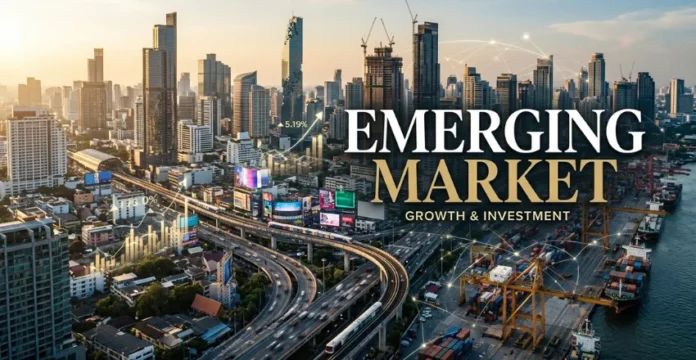
An emerging market is an economy moving toward the scale, stability, and financial maturity associated with developed countries. These economies often grow faster as their financial systems, regulations, infrastructure, and institutions continue to develop. For U.S. investors, they can offer diversification and growth potential alongside higher economic, currency, and political risks.
Direct answer: An emerging market is a country with a developing economy and increasingly accessible financial markets. It usually sits between a developed market and a frontier market. Investors may gain faster-growth exposure, but they also accept greater volatility, currency risk, political uncertainty, and differences in financial regulation.
| Key point | What it means |
|---|---|
| Economic stage | Developing toward higher income and stronger institutions |
| Financial markets | Established enough for meaningful international investment |
| Common examples | China, India, Brazil, Mexico, Taiwan, and South Africa |
| Main opportunity | Growth and portfolio diversification |
| Main risks | Currency, political, regulatory, liquidity, and market volatility |
| U.S. access | ETFs, mutual funds, ADRs, and some individual securities |
| Classification | Varies among MSCI, S&P, FTSE Russell, and other organizations |
Key Takeaways
* There is no single universal definition for emerging economies. * MSCI currently identifies 24 countries within its emerging-markets universe. * Classification depends on investability and accessibility, not only national income. * Faster economic growth does not automatically produce higher investment returns. * U.S. investors commonly access these countries through diversified funds. * Political, currency, governance, and liquidity risks deserve careful attention. * Country classifications can change as markets develop or accessibility changes.
What Defines an Emerging Market?
No international organization provides a single definition everyone follows. The International Monetary Fund, MSCI, S&P, and other organizations use different classification methods. This explains why one country can receive different labels from different institutions. MSCI focuses heavily on market size, liquidity, accessibility, and investability when classifying equity markets. Its framework considers whether international investors can enter, trade, and move capital efficiently. MSCI currently lists 24 countries across its emerging-markets indexes.
MSCI explains its classification framework here. Economic development still matters, but income alone cannot determine a country’s investment classification. A wealthy country may retain an emerging classification because its financial market has accessibility limitations. Another country may progress as regulations, trading systems, and investor access improve. This distinction matters for American investors comparing international funds. A fund follows the classification system selected by its index or investment manager. Two funds labeled similarly can therefore hold different countries and sector exposures.
Common Characteristics of Emerging Economies
These countries differ widely in population, politics, industries, resources, and income levels. Still, several characteristics frequently appear across the group. Understanding them helps explain both their opportunity and their risk.
Faster Economic Development
Many developing economies have more room to increase productivity, infrastructure, urbanization, and consumer spending. Growing middle classes can create demand for housing, financial services, technology, transportation, and consumer products. These forces can support business expansion over the long term.
Faster national growth does not, however, guarantee stronger stock returns. Company valuations, exchange rates, interest rates, and investor expectations still influence investment results. Investors should separate economic growth from expected portfolio performance.
Financial Markets That Are Still Maturing

Emerging exchanges usually have meaningful trading activity and established public companies. Their markets can still be less liquid than those in the United States. Rules governing foreign ownership, settlement, disclosure, and capital movement may also differ. This middle position separates them from many frontier economies. Frontier markets generally have smaller exchanges and more limited access. Developed markets usually provide deeper liquidity and more established financial infrastructure.
Growing Access to Global Capital
International participation tends to increase as markets mature. Local companies may issue shares, bonds, or depositary receipts to reach foreign investors. Governments may also improve trading rules and settlement systems to attract global capital. That process can support economic expansion, but it can create sensitivity to foreign investment flows. Rapid withdrawals can pressure currencies and asset prices. Global interest-rate changes can therefore sharply affect these markets.
Emerging Markets vs. Developed and Frontier Markets
The three classifications describe different stages of market development rather than simple rankings of national quality. S&P defines a frontier market as a developing market with lower capitalization, liquidity, or accessibility than an emerging one. Developed markets meet higher standards for financial and capital-market maturity. S&P’s classification methodology explains these distinctions.
| Feature | Developed markets | Emerging markets | Frontier markets |
|---|---|---|---|
| Market maturity | High | Moderate and improving | Earlier stage |
| Liquidity | Usually deep | Moderate to high | Often limited |
| Investor accessibility | Generally high | Improving, with some restrictions | Often restricted |
| Economic stability | Usually higher | Varies significantly | Often less predictable |
| Growth potential | Usually moderate | Often higher | Potentially high |
| Typical volatility | Lower | Higher | Often highest |
| Examples | United States, Japan, Canada | India, Brazil, Mexico | Several smaller developing markets |
These boundaries can move over time. A country can improve accessibility and graduate into another classification. Market restrictions or structural changes can also cause a downgrade. For example, MSCI announced Greece’s move from emerging to developed status in March 2026. The change is scheduled for the May 2027 Index Review. Greece therefore remains part of MSCI’s current emerging universe before implementation.
Which Countries Are Emerging Markets?
MSCI’s current emerging-markets group covers countries across Asia, Latin America, Europe, Africa, and the Middle East. Major members include China, India, Taiwan, South Korea, Brazil, Mexico, Saudi Arabia, and South Africa. Smaller members also contribute to the broader index. The exact list depends on the index provider.
Investors should not assume that a country automatically belongs in every emerging-markets benchmark. Classification methodologies and implementation dates can differ between providers. MSCI reported that its emerging-markets indexes covered 24 countries in late 2026. Its broader index family represented more than one thousand companies. Current MSCI emerging-markets information is available on its index page. The country mix also affects sector exposure. MSCI reported in 2026 that Taiwan had become its largest emerging-markets country weight. Semiconductor companies consequently have a major influence on broad index performance.
Why U.S. Investors Consider Emerging Markets
Diversification is one of the strongest reasons Americans consider international investments. A U.S.-heavy portfolio can become concentrated in domestic industries and economic conditions. Overseas exposure adds companies influenced by different consumers, currencies, policies, and economic cycles. The SEC’s Investor.gov guide to international investing names diversification and growth as two major reasons to invest abroad, and warns that foreign investments add 3 risk areas: information, cost, and market risks. Growth potential provides another attraction.
Expanding populations, infrastructure spending, digital adoption, manufacturing, and rising consumption can create long-term business opportunities. Yet companies should evaluate those trends country by country. Business owners face similar questions when evaluating international expansion. ENF Blogs’ guide to improving a company and exploring new markets highlights research, customer behavior, and local regulations. Those considerations become more important when entering economies with different legal and commercial systems.
Main Risks U.S. Investors Should Understand
Higher potential growth comes with risks that may be less familiar to domestic investors. These risks can affect individual securities and diversified funds alike. Understanding them is more useful than assuming every developing economy behaves similarly.
Currency Risk
A foreign investment can rise locally while losing value after conversion into U.S. dollars. Currency movements therefore influence an American investor’s final return. Sharp depreciation can offset strong company performance. Exchange rates respond to inflation, interest rates, trade balances, capital flows, and political conditions. Those forces can move quickly during periods of uncertainty. Currency exposure deserves attention before choosing a fund or security.
Political and Regulatory Risk
Governments can change taxes, ownership rules, capital controls, or industry regulations. Elections and geopolitical disputes may also affect market confidence. Some sectors face more direct government involvement than investors encounter in the United States. Rules surrounding foreign investors can change as markets develop. Investors should review a fund’s country exposure instead of relying only on its name. The same label can hide meaningful differences in political risk.
Liquidity and Market-Access Risk
Some exchanges have lower trading volumes and fewer active participants. Selling large positions can therefore become harder under stress. Wider trading spreads may also increase investment costs. FINRA advises investors to consider liquidity, concentration, political instability, and market structure when examining developing markets. It also distinguishes emerging countries from less-developed frontier markets. FINRA’s investor guidance explains these risks.
Information and Governance Differences
Disclosure standards can vary between countries. Investors may receive less detailed information than they expect from U.S.-listed companies. Language differences can make independent research harder as well. Corporate ownership structures may also differ substantially. Governments, founding families, or controlling shareholders can hold large stakes. Those structures can affect minority shareholder rights and corporate decisions.
How Americans Can Invest
Most U.S. investors do not need foreign brokerage accounts to gain exposure. Broad ETFs and mutual funds can hold hundreds of international securities in a single investment. Country-specific and regional funds provide narrower exposure for investors who understand the added concentration risk. American depositary receipts, commonly called ADRs, offer another route. They represent shares of foreign companies while trading in the United States. Individual ADRs still expose investors to company-specific and country-specific risks. Broad funds can reduce the impact of one individual company.
They cannot eliminate currency, geopolitical, or country-concentration risks. Investors should check holdings, expense ratios, geographic weights, and benchmark methodology before buying. Market selection also matters for businesses, not just investors. A company considering overseas expansion should research customers before allocating significant capital. ENF Blogs’ discussion of building accurate business contact data shows why precise audience research matters before outreach begins.
A Practical Way to Evaluate an Emerging Economy
Start by checking how major index providers classify the country. Then examine its financial-market accessibility, currency stability, political environment, and major industries. This creates a broader picture than relying on GDP growth alone. Next, study how concentrated the local stock market is. One industry or several large companies may dominate a country’s index. A broad international fund can therefore contain more concentration than its name suggests.
Finally, decide whether the exposure serves a specific portfolio purpose. Diversification is different from chasing recent returns. Your allocation should match your time horizon and loss tolerance. Businesses should apply the same discipline before expansion. Local regulation, customer demand, legal structure, and operating costs all matter. ENF Blogs’ article of incorporation guide offers useful background on how legal structure affects business operations in the United States.
Are Emerging Markets Right for Every Investor?
They can play a role in a diversified portfolio, but they are not appropriate for everyone. Investors who need stable short-term access to money may dislike their volatility. People uncomfortable with currency and political risk may prefer broader international exposure. Risk tolerance matters more than excitement about a fast-growing economy.
A diversified fund can spread company-specific risk, but international risks remain. Investors should understand what they own before deciding how much exposure fits their plan. No allocation guarantees stronger returns. Past performance also cannot establish what a country or index will earn next. A financial professional can help when international holdings materially affect retirement or other major goals.
Frequently Asked Questions
What is an emerging market?
It is a developing economy with financial markets that are becoming larger, more liquid, and more accessible to international investors. It generally has more mature investment infrastructure than a frontier economy. It has not yet reached every characteristic associated with developed markets.
Is China considered an emerging economy?
MSCI currently includes China in its emerging-markets indexes. China represents a major share of global economic activity and international equity markets. Its classification reflects MSCI’s market methodology rather than a simple judgment about economic size.
Is India an emerging economy?
Yes, India is included in major emerging-markets indexes, including MSCI’s benchmark. Its large population, growing economy, and public equity market make it a major international investment destination. Classification can still differ across organizations and methodologies.
Are emerging markets riskier than U.S. stocks?
They generally introduce additional currency, political, regulatory, liquidity, and information risks. Individual countries and companies can differ greatly, so risk cannot be reduced to one label. Diversification may reduce company-specific exposure without eliminating broader market risks.
Can I invest through a U.S. brokerage account?
Many American brokerage accounts provide access through ETFs, mutual funds, and U.S.-traded ADRs. Available products and fees vary by brokerage firm. Investors should review each fund’s holdings and costs before deciding.
Why do countries change market classifications?
Financial markets develop, regulations change, and investor access can improve or deteriorate. Index providers periodically review those conditions using their own standards. A reclassification can affect benchmarks, fund holdings, and trading around implementation dates.
The Bottom Line
Emerging economies occupy the broad space between mature developed markets and earlier-stage frontier markets. They can offer access to expanding industries, consumers, infrastructure, and international diversification. Those opportunities come with risks that require more research than a simple growth story suggests. For U.S. investors, the most practical approach often starts with understanding a fund’s benchmark. Check its countries, sector weights, costs, and concentration before committing money.
Treat the classification as a research starting point rather than an automatic reason to invest. Markets also change, so never treat classifications as permanent. Greece’s scheduled MSCI reclassification illustrates how a country’s status can evolve. Reviewing current index-provider information helps keep international investment decisions grounded in today’s market structure. —