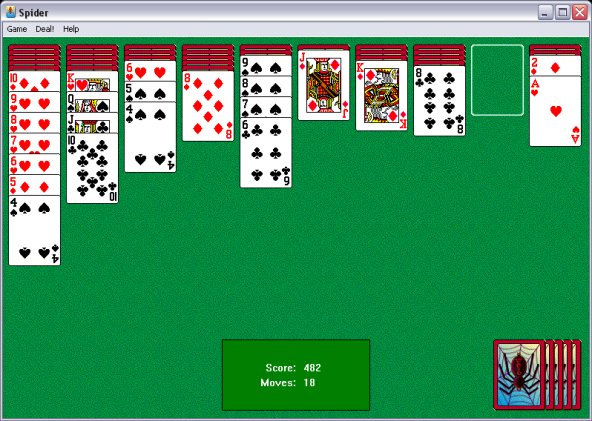
The growing demand for digital entertainment has brought a wave of mobile and browser-based games to people seeking brief escapes or mental refreshment. Yet among the loud, fast-paced options, one classic game continues to captivate people who prefer thoughtful decision-making and mental clarity. Online spider solitaire offers a level of depth that many modern games fail to deliver. Its structure rewards focus, foresight, and planning traits that appeal to individuals who enjoy solving problems and thinking a few steps ahead.
More than just a nostalgic favorite, this version of solitaire allows for flexibility while offering consistent cognitive engagement. Whether it’s a quiet morning, a midday pause, or a wind-down at the end of a long day, the game adapts to the rhythm of your attention. Every deal is unique, demanding strategic recalibration, but never at the expense of clarity. That blend of simplicity and challenge creates a mental environment perfect for sharpening attention and relaxing at the same time.
This is a game where the player controls the pace. There are no ticking clocks, no race against opponents, no artificial rush. Online spider solitaire lets you slow down, assess, and act with precision. It’s this self-guided process that helps elevate it above distractions and turn it into something more valuable: a thinking tool wrapped in a quiet pastime.
Strategy at the Core of Play
Online spider solitaire works so well for analytical thinkers because of the way it structures choice. With each card placed on the tableau, there are decisions to be made that influence the round’s outcome. Success requires looking beyond immediate gratification and instead focusing on long-term consequences. Choosing whether to open a new card from the deck, move an entire column, or delay a play becomes a matter of logic and awareness. It’s not simply about finding an open spot it’s about reading the board, anticipating problems, and building toward the win with each turn.
Each variation offers different levels of difficulty. Single-suit games allow for simpler visual processing and are ideal for those learning the game. Two-suit and four-suit formats increase the complexity by introducing more variables to track. These versions are where strategic minds flourish. Players are required to plan entire sequences and think ahead multiple moves. Making a hasty decision can quickly lead to a blocked stack, forcing them to reevaluate and reset.
But the learning curve isn’t steep in a punishing way. Every round provides an opportunity to observe patterns and practice calculated thinking. The brain begins to recognize common setups, traps, and opportunities. This kind of pattern recognition builds over time, enhancing both memory and decision-making speed. That’s part of the quiet genius behind online spider solitaire it becomes a form of daily training for your mind without feeling like work.
When playing regularly, you begin to notice how your approach to problem solving outside of the game changes. A clearer sense of process emerges. Tasks feel less scattered. There’s a subtle yet real carryover from digital board to daily responsibility, where measured action replaces reaction.
Focus Without Distraction
Unlike many modern digital games that rely on visual stimulation, competitive leaderboards, and in-app purchases, online spider solitaire does away with the excess. It doesn’t need a complex narrative or avatar customization to pull players in. The draw comes from the experience of engaging deeply with the game board itself. Its minimalist design supports attention, not overstimulation. This makes it especially suitable for people who want to be mentally active without becoming mentally drained.
The quiet pace promotes a particular type of focus. Rather than chasing after achievements or managing timers, players find themselves immersed in a different kind of goal: stability, order, and logic. This isn’t the kind of game you play while mindlessly multitasking. It asks for presence. The experience becomes both a mental reset and a satisfying challenge, encouraging players to step into a more intentional state of mind.
Because the game avoids unnecessary distractions, it can also be played during short breaks throughout the day. It doesn’t demand long sessions or require players to remember where they left off. Each round is self-contained. That makes it easier to incorporate into daily routines without adding pressure or screen fatigue. Whether you’re on a commute, between meetings, or unwinding at night, the game is ready with a new puzzle that fits into any schedule.
The game’s structure ensures that your attention is always where it matters: on the cards, on the sequence, on the strategy. For people who spend their workdays split between tasks and notifications, this type of singular focus can be surprisingly refreshing. It feels like a mental cleanse, achieved not through silence but through structured engagement.
A Game That Grows With You
What makes online spider solitaire particularly engaging over time is its ability to scale with your skills. When you first begin, the focus is on mastering basic mechanics. Where do the cards go? How can stacks be cleared? How do sequences work? But as familiarity builds, so does the complexity of your thinking. You begin anticipating what lies beneath the face-down cards. You choose not just which move is possible, but which move opens up new options later.
This evolution mirrors the kind of growth found in deeper strategy games, but without the overwhelming systems. There are no rules to memorize beyond what the board already shows. Instead, you discover depth through repetition and reflection. As your understanding grows, the game remains challenging not because it changes, but because your goals shift. A win becomes more than clearing the cards. It becomes about doing so efficiently, or without needing to undo previous choices, or by predicting outcomes more consistently.
For strategic minds, that growth is what keeps the game relevant. It’s not static. It evolves in step with the player. Even after hundreds of rounds, there’s still something new to consider in each layout. The beauty lies in its quiet variation. The cards are dealt randomly, but the way forward is built through discipline, experimentation, and creativity.
When Thoughtful Play Becomes a Daily Habit
One of the unexpected rewards of playing online spider solitaire is how easily it becomes a grounding routine. It doesn’t demand commitment or drain energy. Instead, it fits into the small in-between moments where mental clarity is most needed. A quick game before starting work. A pause during lunch. A way to cool down after handling stressful tasks.
Each round offers a compact space where problem-solving feels contained, solvable, and satisfying. The sense of completion that comes from solving a game even a single-suit version feeds a sense of control that’s often missing in the chaos of the day. That alone makes it a valuable part of any busy person’s toolkit.
It’s not uncommon for players to find themselves returning not out of habit, but out of choice. Because the game gives more than it takes. It doesn’t drain attention or demand emotional involvement. It simply provides a structured mental task with clear rules and endless variety. The end result is a state of calm attention, something more useful than escape and more lasting than entertainment.
Apart from that, if you are interested to know about Easy Instructions and Rules for How to Play Skip-Bo Cards? then visit our Gaming category.