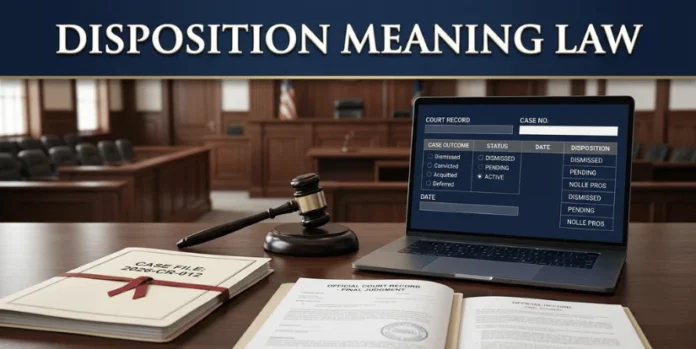
Disposition meaning law refers to the legal outcome of a court case, such as a conviction, acquittal, dismissal, settlement, or pending status. Understanding the disposition helps you read court records and background checks accurately. It can also show whether a case ended favorably or still requires further action.
The same thing happens on a background check report from an employer: one column, three cryptic words, and a hiring decision hanging off it. The disposition meaning law works with is narrow and specific: it’s how the case ended, and nothing else. Here’s how to read every code you’re likely to see, and what to do if yours is blank.
| What does disposition meaning law mean here? | How a case finally ended, in one word or phrase |
| Where does it show up? | Court dockets, arrest records, screening reports, licence applications |
| Who writes it? | The clerk of court, who reports it to the state repository and the FBI |
| Criminal version | Guilty, acquitted, dismissed, dropped, deferred, pending |
| Civil version | Judgment, settlement, default, dismissal with or without prejudice |
| Worst thing you can see | An old arrest with nothing filled in at all |
| Other legal sense | Handing over property, as in a will or an estate |
Short answer: In American courts, this term names the outcome of a case: convicted, acquitted, dismissed, nolle prosequi, deferred, or still pending. Your clerk of court records it on the docket, then reports it to the state criminal history repository and the FBI. It isn’t the sentence, and it isn’t proof of guilt by itself.
Key takeaways before you read further
- The outcome and the sentence are two different fields. One says how the case ended; the other says what you got.
- “Nolle prosequi,” “dismissed,” and “no papered” all mean you weren’t convicted, but they don’t mean the same thing.
- A blank or pending line on a ten-year-old arrest hurts you more than a clean dismissal does.
- You can fix a missing entry yourself, starting with a certified copy from the clerk of court.
- In wills and property law, the same word means something completely unrelated: transferring assets.
The Disposition Meaning Law Gives the Word
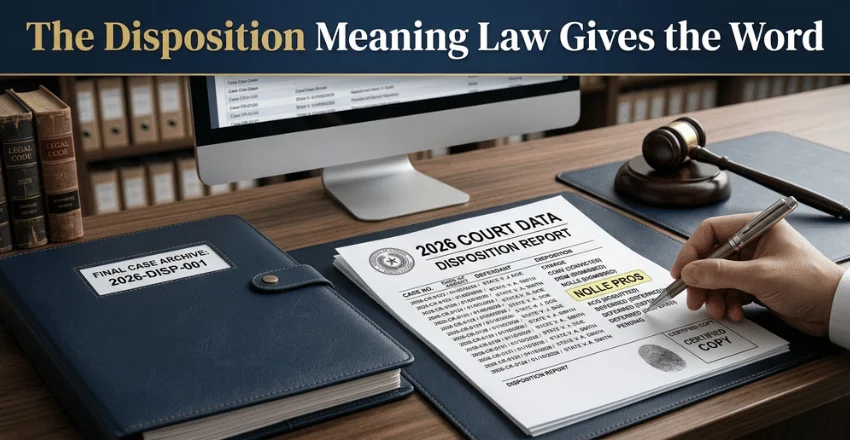
Everyday English uses this word for temperament, but disposition meaning law refers to something more specific: the point at which a court case stops being open. A cheerful person may have a sunny disposition, while a legal disposition describes the case outcome. So, when a judge sentences you to 90 days, two separate things have happened: finding you guilty is the outcome, while 90 days is the sentence. Screening companies list these in different columns, yet people often mix them up.
How that result travels matters too. Your county clerk enters it first. That result travels to the state’s criminal history repository, usually run by the state police or a bureau of identification. From there, it feeds the FBI’s national database, which is what most fingerprint-based checks search.
Break any link in that chain, and the record goes stale. High-profile cases show the same gap. Readers who go looking for what happened to a figure like Jesus Alfredo Guzman Salazar often find charges reported loudly and outcomes reported quietly, or not at all.
Criminal Codes, Decoded
Abbreviations vary by state, and some states use numeric codes instead of words. Underlying categories stay consistent. Match yours to this table.
Common entries on a criminal record and what each one means for you
| Convicted / Guilty / CONV | You pleaded guilty, or a judge or jury found you guilty | Yes | Reportable, often with no federal time limit |
| Acquitted / Not guilty / ACQ | A trial ended in your favour | No | Strongest possible non-conviction result |
| Dismissed / DISM | The judge threw the charge out | No | Clean, though the arrest may still appear |
| Nolle prosequi / Nolle pros / NP | The prosecutor chose not to pursue it | No | Good, but charges can sometimes be refiled |
| Nolo contendere / No contest | You didn’t admit guilt but accepted punishment | Treated as one for sentencing | Usually reported the same as a guilty plea |
| Deferred adjudication | You pleaded, and the court holds off on judgment while you complete conditions.s | Not if you finish | Explain it, because screeners often misread it |
| Diversion / Pretrial diversion | A program instead of prosecution, dismissal on completion | No | Favorable once completion is recorded |
| Adjudication withheld | Guilt established, formal conviction withheld (common in Florida) | No, for most purposes | Sits in a gray zone, worth documenting |
| Bound over | A lower court found probable cause and sent the case up | No | Not an ending at all, just a stage |
| Pending / Open | Nobody has resolved it yet | Unknown | Reads as unresolved risk |
| No papered / Declined | Police arrested you, the prosecutor never filed charges | No | Often mistaken for pending, so clarify it |
| Vacated / Set aside | A court undid an earlier conviction | No, once vacated | Needs a certified order to prove |
| Expunged / Sealed | Access to the record is destroyed or restricted | No | Should stop appearing on standard checks |
Two rows trip people up more than the rest. Bound over isn’t an outcome; it’s a transfer, so a record that stops there is unfinished. And “no papered” is courthouse slang used in Washington, D.C. and some federal districts for an arrest that never became a case.
Traffic Court Runs on Its Own Vocabulary
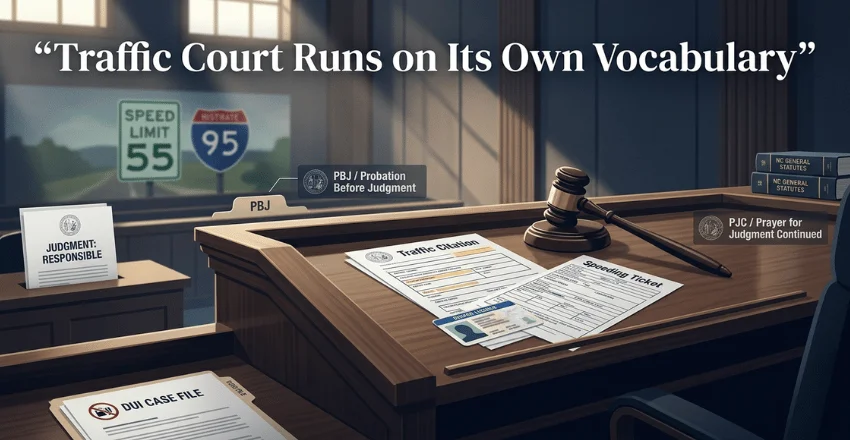
Minor traffic matters use words you won’t find in the criminal table. In many states, a speeding ticket is a civil infraction, so you’re found “responsible” rather than guilty. Maryland offers probation before judgment. North Carolina has a prayer for judgment continued. Both let a driver avoid points without a straight conviction.
DUI is the exception. It’s criminal in every state, and it produces a criminal record entry that follows the vehicle’s driver, not the vehicle. Someone researching a used 2013 Hyundai Veloster won’t inherit the previous owner’s DUI, though insurers do treat the car’s own accident history as a separate question.
Civil Cases Get Resolved Too
The disposition, meaning the law applies in civil court, has different labels. Tenant screening and credit reports lean on these, so they’re worth knowing.
- Judgment for plaintiff or defendant: the court decided who wins and how much is owed.
- Default judgment: one side never responded, so the other side won automatically. Very common in debt collection and eviction files.
- Dismissed with prejudice: finished for good; nobody can refile it.
- Dismissed without prejudice: closed for now; refiling is still possible.
- Settled or discontinued: the parties worked it out and told the court to close the file.
- Consent judgment: both sides agreed on the terms and asked a judge to make them enforceable.
An eviction filed against you and later settled still shows up in tenant screening databases. Landlords frequently see the filing and skip the ending, which is exactly the problem a clear record solves.
Disposition Date vs. Arrest Date, and Why a Blank Line Costs You
Two dates sit on every criminal entry. One marks the day police booked you. Its partner marks the day the case closed. Reporting rules hang on which one a screening company uses. Under the federal Fair Credit Reporting Act, an arrest that never produced a conviction generally can’t be reported after seven years. Convictions carry no federal time limit, though several states cap them at seven years anyway. So an old arrest with nothing after it can be read either way, and that ambiguity is what stalls applications.
Missing outcomes are common. The Bureau of Justice Statistics surveyed state criminal history systems for its 2022 report. It found that, as of December 31, 2022, the states surveyed had final case outcomes on file for an average of 73% of arrests. Its Survey of State Criminal History Information Systems breaks that down state by state.
Put plainly: about one arrest in four sits in a state database with no ending attached. Yours could be one of them even though the judge dismissed it years ago.
How to Fix a Missing or Wrong Entry
Nobody does this for you. Work these five steps in order.
- Get proof from the court. Ask the clerk of court in the county where the case was heard for a certified copy of the final order. Fees usually run $5 to $25 per case.
- Send it to your state repository. Every state has an agency that maintains criminal history files, often the state police or a bureau of identification. Mail or upload the certified copy with a written correction request.
- Pull your FBI Identity History Summary. Request your own copy, review it, and challenge anything wrong. The FBI routes challenges back to the agency that submitted the entry, so keep your certified order handy.
- Dispute with the screening company. If a report already cost you a job, the Fair Credit Reporting Act gives you the right to dispute it directly with the company that sold it. They have to investigate.
- Keep a personal copy forever. Scan the certified order and store it. You will need it again for licensing, housing, and immigration paperwork.
Expect four to eight weeks for a state repository to update. Start before you need it, not the week an offer is on the table.
The Other Meaning: Property, Wills and Estates

Property lawyers use the same word for something unrelated to guilt. Here it means transferring assets: selling, gifting or leaving them to someone. A will contains testamentary provisions that hand specific property to named people, and the residuary clause sweeps up whatever’s left.
You’ll also see “final disposition” on funeral paperwork, where it means burial or cremation. Same word, entirely different job. Coverage of a public death, such as Janet Auchincloss Rutherfurd’s death, often mentions both senses within a few paragraphs: how she died, and where her assets went.
Your Next Step
Pull your own records before anyone else does. Order your state criminal history report and your FBI Identity History Summary, then compare each entry against what you remember. Any line that’s blank, pending, or wrong gets a certified court order attached to it.
One honest note: this is general information, written to help you read your paperwork. It isn’t advice about your specific case, and a local attorney who can see the actual file will always beat an article. If a charge is affecting your job, housing, or immigration status, that call is worth making today.
Frequently Asked Questions
It’s the final result of the charge: guilty, not guilty, dismissed, dropped, deferred, or still open. It answers what happened to the case, not what happened to you afterward.
It’s the weakest position to be in. Employers read “unresolved” as risk, and many states let them consider open charges. If the case actually closed, the record is simply out of date, and you should correct it.
Close, but not identical. A dismissal comes from the judge. Nolle prosequi comes from the prosecutor, who is choosing not to proceed. In some states, charges can be refiled later, so ask whether yours was entered with prejudice.
Often yes. Dismissal ends the case; it doesn’t erase the arrest. Expungement or sealing is the step that removes it from standard checks, and eligibility rules differ by state.
For most state-law purposes, no. Federal immigration and firearms rules sometimes treat it as one anyway. If either applies to you, get advice specific to your case before assuming you’re clear.
Days in well-funded counties, months in others. Manual paper reporting is still the reason some records never get updated at all.